


Page 666 - ACCCN's Critical Care Nursing
P. 666
Trauma Management 643


               TABLE 23.9  Spleen injury scale 62                   TABLE 23.10  Liver injury scale 62

                   Grade*    Injury description                         Grade*    Injury description
               I  Haematoma  Subcapsular, <10% surface area         I   Haematoma  Subcapsular, <10% surface area
                  Laceration  Capsular tear, <1 cm parenchymal depth    Laceration  Capsular tear, <1 cm parenchymal depth
               II  Haematoma  Subcapsular, 10–50% surface area      II  Haematoma  Subcapsular, 10%–50% surface area
                             Intraparenchymal, <5 cm in diameter                  Intraparenchymal, <10 cm in diameter
                   Laceration  Parenchymal depth 1–3 cm not involving a   Laceration  Parenchymal depth 1–3 cm, <10 cm in length
                              trabecular vessel
                                                                    III  Haematoma  Subcapsular, >50% surface area or expanding
               III  Haematoma  Subcapsular, >50% surface area or expanding;       Ruptured subcapsular or parenchymal
                             Ruptured subcapsular or parenchymal                    haematoma
                              haematoma                                 Laceration  Parenchymal depth >3 cm
                             Intraparenchymal haematoma >5 cm or
                              expanding                             IV  Laceration  Parenchymal disruption involving 25–75% of
                   Laceration  Parenchymal depth >3 cm or involving                 hepatic lobe or 1–3 Couinaud’s segments
                                                                                    within a single lobe
                              trabecular vessels
                                                                    V   Laceration  Parenchymal disruption involving >75% of
               IV  Laceration  Laceration involving segmental or hilar vessels      hepatic lobe or >3 Couinaud’s segments
                              producing major devascularisation (>25%               within a single lobe
                              of spleen)
                                                                        Vascular  Juxtahepatic venous injuries; i.e. retrohepatic
               V  Laceration  Completely shattered spleen                           vena cava/central major hepatic veins
                  Vascular   Hilar vascular injury that devascularises spleen  VI  Vascular  Hepatic avulsion
               *Advance one grade for multiple injuries, up to grade III.
                                                                    *Advance one grade for multiple injuries, up to grade III.


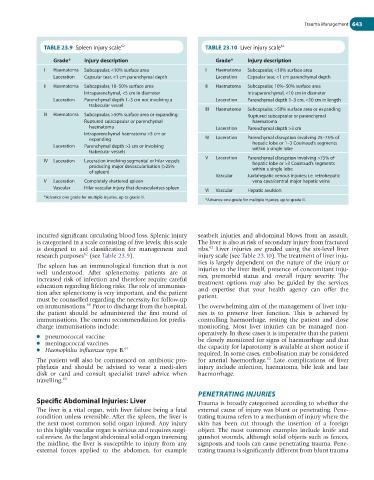
             incurred significant circulating blood loss. Splenic injury   seatbelt injuries and abdominal blows from an assault.
             is categorised in a scale consisting of five levels; this scale   The liver is also at risk of secondary injury from fractured
             is  designed  to  aid  classification  for  management  and   ribs.   Liver  injuries  are  graded  using  the  six-level  liver
                                                                      62
                            62
             research purposes  (see Table 23.9).                 injury scale (see Table 23.10). The treatment of liver inju-
                                                                  ries is largely dependent on the nature of the injury or
             The  spleen  has  an  immunological  function  that  is  not   injuries to the liver itself, presence of concomitant inju-
             well  understood.  After  splenectomy,  patients  are  at   ries,  premorbid  status  and  overall  injury  severity.  The
             increased risk of infection and therefore require careful   treatment  options  may  also  be  guided  by  the  services
             education regarding lifelong risks. The role of immunisa-  and  expertise  that  your  health  agency  can  offer  the
             tion after splenectomy is very important, and the patient   patient.
             must be counselled regarding the necessity for follow-up
                             68
             on immunisations.  Prior to discharge from the hospital,   The overwhelming aim of the management of liver inju-
             the  patient  should  be  administered  the  first  round  of   ries  is  to  preserve  liver  function.  This  is  achieved  by
             immunisations. The current recommendation for predis-  controlling  haemorrhage,  resting  the  patient  and  close
             charge immunisations include:                        monitoring.  Most  liver  injuries  can  be  managed  non-
                                                                  operatively. In these cases it is imperative that the patient
             l  pneumococcal vaccine
             l  meningococcal vaccines                            be closely monitored for signs of haemorrhage and that
             l  Haemophilus influenzae type B. 69                 the capacity for laparotomy is available at short notice if
                                                                  required. In some cases, embolisation may be considered
                                                                                        62
             The patient will also be commenced on antibiotic pro-  for  arterial  haemorrhage.   Late  complications  of  liver
             phylaxis  and  should  be  advised  to  wear  a  medi-alert     injury include infection, haematoma, bile leak and late
             disk  or  card  and  consult  specialist  travel  advice  when   haemorrhage.
             travelling. 69
                                                                  PENETRATING INJURIES
             Specific Abdominal Injuries: Liver                   Trauma is broadly categorised according to whether the
             The liver is a vital organ, with liver failure being a fatal   external cause of injury was blunt or penetrating. Pene-
             condition unless reversible. After the spleen, the liver is   trating trauma refers to a mechanism of injury where the
             the next most common solid organ injured. Any injury   skin  has  been  cut  through  the  insertion  of  a  foreign
             to this highly vascular organ is serious and requires surgi-  object.  The  most  common  examples  include  knife  and
             cal review. As the largest abdominal solid organ traversing   gunshot wounds, although solid objects such as fences,
             the  midline,  the  liver  is  susceptible  to  injury  from  any   signposts and tools can cause penetrating trauma. Pene-
             external  forces  applied  to  the  abdomen,  for  example   trating trauma is significantly different from blunt trauma

