


Page 669 - ACCCN's Critical Care Nursing
P. 669
646  S P E C I A LT Y   P R A C T I C E   I N   C R I T I C A L   C A R E

         in  a  closed  spaced  as  well  as  if  there  are  facial  burns,
         singed nasal hairs or carbonaceous debris in the mouth
                                    71
         or pharynx or in the sputum.  The specific changes are             9%
         dependent on the type of substances inhaled at the time
         of injury. In addition, the size of the smoke particles that
         are inhaled will affect the location of any injury. If coarse
         smoke  particles  are  inhaled,  these  will  primarily  be
         deposited in the upper tracheobronchial tree, whilst fine          18%                 18%
         smoke  particles  will  usually  be  lodged  in  the  alveoli.
         Patients with inhalation burn injury will usually experi-          Front
         ence  upper  airway  oedema  and  bronchospasm  in  the     9%     18%     9%
         early  stages,  with  the  airway  disease  progressing  to  the                        18%
         small airways in subsequent days. 71,72,75                         Back           9%    Front
                                                                            1%                            9%
         Clinical Manifestations                                                                18%

         The  most  prominent  clinical  manifestations  of  burn                               Back
         injury are the dermal signs of injury. ANZBA categorise
         burns as follows: 74                                          18%   18%
            1.  Epidermal burns are limited to injury to the epi-
               dermis and tend to be very painful, with a common                              14%    14%
               example being sunburn. The skin is pink to red in
               colour and remains intact. The surrounding tissues
               may be oedematous and there is no blistering. This
               burn injury will usually heal within 7 days.
            2.  Superficial  partial-thickness  burn  injury  involve   A                B
               the epidermal and superficial dermal layers and are                                         78
               generally  red  or  mottled  in  appearance  and  the   FIGURE 23.7  Diagram of the ‘rule of nines’ (A), adult; (B), child.
               underlying skin will blanch with pressure, demon-
               strating that perfusion is intact; blisters are a hall-
               mark symptom. This degree of burn injury is very
               painful and healing may take up to 14 days. There    pinprick is lost. The coagulated dead skin of a full
               is  usually  a  lot  of  wound  exudate  in  the  first  72   thickness burn, which has a leathery appearance,
               hours where the skin is broken.                      is called eschar.
            3.  Mid-dermal partial-thickness injuries extend a part
               way  into  the  dermis.  They  have  a  large  zone  of   Assessment of the total body surface area
               damaged  non-viable  tissue  extending  into  the   (TBSA) of burns
               dermis, with damaged but viable tissue at the base.   The extent of injury is best described using the percentage
               Preservation  of  the  damaged  but  viable  tissue   of the total body surface area that sustained burns. The
               (particularly in the initial period following injury)   measurement  of  burn  surface  area  is  important  during
               is pivotal to preventing burn wound progression.   the initial management of people with burns for estimat-
               As some of the nerve endings remain viable, pain   ing fluid requirements and determining need for transfer
               is  present  but  is  less  severe  when  compared  to   to  a  burns  service.  Erythema  should  not  be  included
               superficial burns. Similarly, as some of the capil-  when calculating burn area.
               laries  remain  viable,  capillary  return  is  present,   There  are  several  methods  that  provide  a  reproducible
               albeit  delayed.  Blisters  may  be  present  and  the   estimation of the area of surface area burns. These are:
               underlying  dermis  is  a  variable  colour  (pale  to
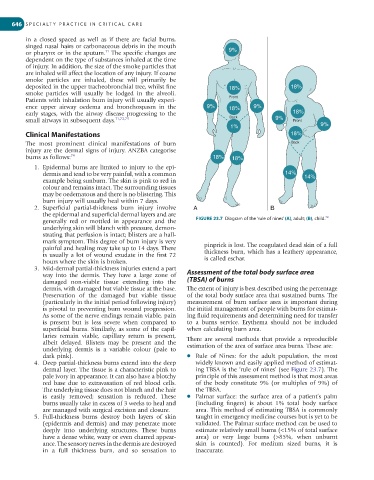
               dark  pink).                                   l  Rule  of  Nines:  for  the  adult  population,  the  most
            4.  Deep partial-thickness burns extend into the deep   widely known and easily applied method of estimat-
               dermal layer. The tissue is a characteristic pink to   ing TBSA is the ‘rule of nines’ (see Figure 23.7). The
               pale ivory in appearance. It can also have a blotchy   principle of this assessment method is that most areas
               red  base  due  to  extravasation  of  red  blood  cells.   of  the  body  constitute  9%  (or  multiples  of  9%)  of
               The underlying tissue does not blanch and the hair   the TBSA.
               is  easily  removed;  sensation  is  reduced.  These   l  Palmar  surface:  the  surface  area  of  a  patient’s  palm
               burns usually take in excess of 3 weeks to heal and   (including  fingers)  is  about  1%  total  body  surface
               are managed with surgical excision and closure.   area.  This  method  of  estimating  TBSA  is  commonly
            5.  Full-thickness  burns  destroy  both  layers  of  skin   taught in emergency medicine courses but is yet to be
               (epidermis and dermis) and may penetrate more     validated. The Palmar surface method can be used to
               deeply  into  underlying  structures.  These  burns   estimate relatively small burns (<15% of total surface
               have a dense white, waxy or even charred appear-  area)  or  very  large  burns  (>85%,  when  unburnt
               ance. The sensory nerves in the dermis are destroyed   skin  is  counted).  For  medium  sized  burns,  it  is
               in  a  full  thickness  burn,  and  so  sensation  to   inaccurate.

