


Page 703 - ACCCN's Critical Care Nursing
P. 703
680  S P E C I A LT Y   P R A C T I C E   I N   C R I T I C A L   C A R E

         four weeks of age. Boys make up 58% of children admit-
                    4
         ted to ICUs.  The overall ICU mortality rate is 11% for   TABLE 25.1  Guide to maintenance water in
                                         4
         Australia and 13% for New Zealand,  however the paedi-  healthy children
                               5
         atric mortality rate is 3%.  Over the past 30 years, although
         length of stay and severity of illness to the PICUs have   For each of the first 10 kg body weight: 100 mL/kg/day or
         not essentially changed, mor tality has halved while dis-  4 mL/kg/h
         ability has increased. 6                                + For each of the second 10 kg of body weight: 50 mL/kg/day or
                                                                  2 mL/kg/h
         ANATOMICAL AND PHYSIOLOGICAL                            + For every subsequent kg of body weight: 25 mL/kg/day or
         CONSIDERATIONS IN CHILDREN                               1 mL/kg/h
                                                                                                        2
         Children  require  age-  and  developmentally-appropriate   Weight (kg)  mL/h  mL/kg/day   mL/m /day
         care.  An  appropriate  range  of  paediatric  equipment  is   4      16      100          1600
         required to assess, monitor and treat all ages and sizes
         of  infants  and  children.  The  most  obvious  difference    6      24      100          1800
         is  the  range  of  weights  and  sizes  across  the  paediatric   8  32      100          1920
         population. General considerations based on differences   10          40      100          2040
         between  children  and  adults  are  described  and  then  a
         systems approach is used to identify specific differences.   12       44       88          1960
         Children  tend  to  be  clustered  into  one  of  five  stages:   14  48       82          1890
         infant, toddler, preschool child, school child and adole-  16         52       78          1860
         scent. Developmental considerations for these five stages
         are considered later in the chapter. The terms ‘infants’ and   18     56       75          1840
         ‘children’  are  used  throughout  the  remainder  of  this   20      60       72          1820
         chapter. ‘Infants’ includes all children up to the age of 1
         year and all other age groups are ‘children’.           30            70       56          1580
                                                                 40            80       48          1500
         A number of general considerations, based on anatomical
         and  physiological  differences  from  adults,  need  to  be   50     90       43          1460
         considered for the critically ill child.                60           100       40          1450
         l  Children have increased surface area to volume ratio   70         110       38          1470
            compared with adults, which leads to increased heat   Adapted from (9).
            loss  and  insensible  fluid  losses,  placing  infants  and
            children at increased risk of developing hypothermia
                                                                            10
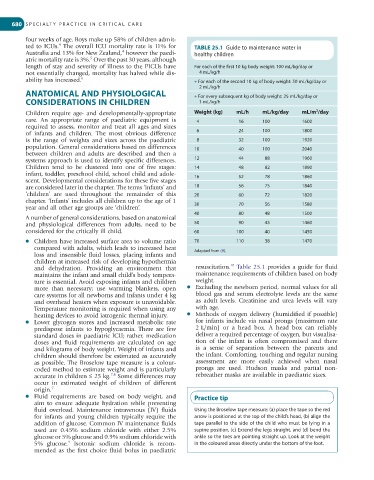
            and  dehydration.  Providing  an  environment  that   resuscitation.  Table 25.1 provides a guide for fluid
            maintains the infant and small child’s body tempera-  maintenance requirements of children based on body
            ture is essential. Avoid exposing infants and children   weight.
            more  than  necessary;  use  warming  blankets,  open     l  Excluding the newborn period, normal values for all
            care systems for all newborns and infants under 4 kg     blood gas and serum electrolyte levels are the same
            and overhead heaters when exposure is unavoidable.     as  adult  levels.  Creatinine  and  urea  levels  will  vary
            Temperature monitoring is required when using any    with age.
            heating devices to avoid iatrogenic thermal injury.  l  Methods of oxygen delivery (humidified if possible)
         l  Lower  glycogen  stores  and  increased  metabolic  rate   for infants include via nasal prongs (maximum rate
            predispose  infants  to  hypoglycaemia.  There  are  few   2 L/min)  or  a  head  box.  A  head  box  can  reliably
            standard doses in paediatric ICU; rather, medication   deliver a required percentage of oxygen, but visualisa-
            doses  and  fluid  requirements  are  calculated  on  age   tion  of  the  infant  is  often  compromised  and  there
            and kilograms of body weight. Weight of infants and   is  a  sense  of  separation  between  the  parents  and
            children should therefore be estimated as accurately   the infant. Comforting, touching and regular nursing
            as  possible.  The  Broselow  tape  measure  is  a  colour-  assessment  are  more  easily  achieved  when  nasal
            coded method to estimate weight and is particularly   prongs  are  used.  Hudson  masks  and  partial  non-
                                     7,8
            accurate in children ≤ 25 kg.  Some differences may   rebreather masks are available in paediatric sizes.
            occur  in  estimated  weight  of  children  of  different
            origin. 7
         l  Fluid  requirements  are  based  on  body  weight,  and   Practice tip
            aim  to  ensure  adequate  hydration  while  preventing
            fluid  overload.  Maintenance  intravenous  (IV)  fluids   Using the Broselow tape measure: (a) place the tape so the red
            for  infants  and  young  children  typically  require  the   arrow is positioned at the top of the child’s head, (b) align the
            addition of glucose. Common IV maintenance fluids    tape parallel to the side of the child who must be lying in a
            used  are  0.45%  sodium  chloride  with  either  2.5%   supine position, (c) Extend the legs straight, and (d) bend the
            glucose or 5% glucose and 0.9% sodium chloride with   ankle so the toes are pointing straight up. Look at the weight
                       9
            5%  glucose.   Isotonic  sodium  chloride  is  recom-  in the coloured areas directly under the bottom of the foot.
            mended  as  the  first  choice  fluid  bolus  in  paediatric

