


Page 705 - ACCCN's Critical Care Nursing
P. 705
682  S P E C I A LT Y   P R A C T I C E   I N   C R I T I C A L   C A R E

         2 mL/kg/hr, with 1 mL/kg/hr in children and 0.5–1 mL/
         kg/hr  in  adolescents.  Other  indirect  evidence  of  poor
         systemic perfusion in infants may include: 15
         l  feeding difficulties
         l  abdominal distension
         l  fluid imbalances
         l  temperature instability
         l  hypoglycaemia
         l  hypocalcaemia
         l  apnoea.
         Indirect evidence of poor systemic perfusion in children
         is  irritability,  then  disorientation  or  lethargy.  Clinical
         signs of reduced cardiac output, typically seen in shock,
         are similar to adults. 16
         RESPIRATORY SYSTEM

         The child’s respiratory system, including airways, contin-
         ues to mature until at least eight years of age, therefore
         the  paediatric  airway  is  described  and  managed  differ-
         ently from the adult’s. Structural and mechanical differ-
         ences predispose infants and young children to respiratory
         compromise. Respiratory compromise leading to apnoeas
         and even respiratory arrest, is a relatively common occur-
         rence in the paediatric population, although specific inci-
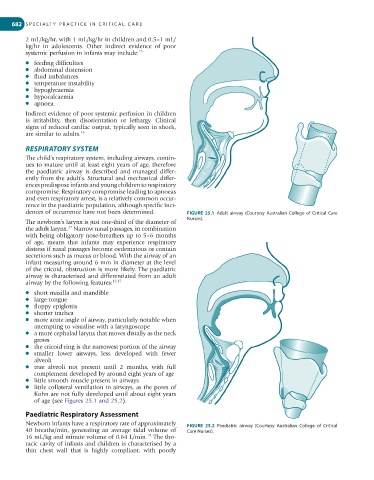
         dences of occurrence have not been determined.       FIGURE  25.1  Adult  airway  (Courtesy  Australian  College  of  Critical  Care
                                                              Nurses).
         The newborn’s larynx is just one-third of the diameter of
                       17
         the adult larynx.  Narrow nasal passages, in combination
         with being obligatory nose-breathers up to 5–6 months
         of  age,  means  that  infants  may  experience  respiratory
         distress if nasal passages become oedematous or contain
         secretions such as mucus or blood. With the airway of an
         infant measuring around 6 mm in diameter at the level
         of the cricoid, obstruction is more likely. The paediatric
         airway is characterised and differentiated from an adult
         airway by the following features: 13,17
         l  short maxilla and mandible
         l  large tongue
         l  floppy epiglottis
         l  shorter trachea
         l  more acute angle of airway, particularly notable when
            attempting to visualise with a laryngoscope
         l  a more cephalad larynx that moves distally as the neck
            grows
         l  the cricoid ring is the narrowest portion of the airway
         l  smaller  lower  airways,  less  developed  with  fewer
            alveoli
         l  true  alveoli  not  present  until  2  months,  with  full
            complement developed by around eight years of age
         l  little smooth muscle present in airways
         l  little collateral ventilation in airways, as the pores of
            Kohn are not fully developed until about eight years
            of age (see Figures 25.1 and 25.2).

         Paediatric Respiratory Assessment
         Newborn infants have a respiratory rate of approximately   FIGURE  25.2  Paediatric  airway  (Courtesy  Australian  College  of  Critical
         40  breaths/min,  generating  an  average  tidal  volume  of   Care Nurses).
                                                 18
         16 mL/kg and minute volume of 0.64 L/min.  The tho-
         racic cavity of infants and children is characterised by a
         thin  chest  wall  that  is  highly  compliant,  with  poorly

