


Page 704 - ACCCN's Critical Care Nursing
P. 704
Paediatric Considerations in Critical Care  681

                                                                  CARDIOVASCULAR SYSTEM
               Practice tip                                       In  infants,  approximately  70%  of  the  haemoglobin  is
                                                                  fetal  haemoglobin  (HbF),  allowing  greater  amounts  of
               If  paediatric  oxygen  masks  are  not  available,  an  adult  sized   oxygen  to  be  carried  for  any  given  PaO 2 .  Circulating
               mask, including a partial non-rebreather mask, can be used in   blood  volume  per  kilogram  decreases  with  age;  in  the
               an emergency. Place the nose section under the child or infant’s   infant,  circulating  volume  is  approximately  85 mL/kg,
               chin in the ‘upside-down’ position.
                                                                  with total body water accounting for 70% of body mass,
                                                                  adjusting  to  the  adult  values  of  65 mL/kg  and  total
                                                                                   13
             CENTRAL NERVOUS SYSTEM                               body water of 60%.  The apex beat is heard at the fourth
                                                                  intercostal space, mid-clavicle, and by around seven years
             Many central nervous system functions, such as locomo-  of age the left ventricle has grown and the apex beat can
             tion and hand–eye coordination, will take from months   be  heard  at  the  fifth  intercostal  space,  as  in  adults.  An
             to years, to fully develop. Functions of the cerebral cortex   infant’s  cardiac  output  is  approximately  500 mL/min,
             are particularly underdeveloped, with myelination of all   which, relative to body weight, is about twice that of an
                                                        11
             major nerve tracts continuing throughout infancy.  Con-  adult.   Heart  rate  is  a  major  determinant  of  cardiac
                                                                       14
             sequently, assessment and management priorities will be   output in infants and young children, as there is limited
             dictated by the level of neurological maturity of the infant   ability to increase stroke volume. Tachycardia is an early
             or  child.  As  with  adults,  neurological  dysfunction  in   sign  of  distress,  but  bradycardia  is  an  ominous  sign  in
             infants and children may be primary or secondary. The   infants and young children, as they are more dependent
             plasticity inherent in the brain of the infant may compen-  on a high heart rate to maintain cardiac output. In infants,
             sate  for  injury  more  readily  than  older  children  and   bradycardia requires resuscitation. 13
             adults  in  some  circumstances,  with  other  areas  of  the
             infant’s  brain  taking  over  function.  Because  the  eight   Arterial  blood  pressure  should  be  appropriate  for  age,
             cranial bones are not yet fused, infants’ skulls cope with   weight and clinical condition. Mean arterial pressure is
             both birth and ongoing growth, which is greatest in the   generally used. Monitoring blood pressure using correct
             first two years of life. In the first year, the cartilaginous   cuff  sizes  is  important  because  incorrect  cuff  size  is  a
             sutures fuse at two points to form the posterolateral fon-  common cause of inaccurate blood pressure readings in
             tanelle. The larger anterior fontanelle closes during the   children. Diastolic blood pressure is recorded at Korot-
             second year as bone is laid down. By around five years of   koff sound 5 (K5); age-related parameters for mean blood
             age, the sutures of the child’s skull are completely fused.    pressure are displayed in Table 25.3. Tachycardia in the
                                                             12
             However the thinner skull will provide less protection to   absence of fever is a more reliable sign than hypotension,
             underlying tissues than the adult skull.             as up to 25% of the child’s circulating volume may be
                                                                  lost  before  hypotension  occurs.  Hypotension  is  thus  a
             A common misconception is that the Monro-Kellie doc-  late  sign  in  children  and  may  indicate  late  decompen-
             trine (see Chapter 16) does not apply to young children   sated shock, particularly following fluid delivery. 14
             and infants with a more compliant skull. While slow rises
             in intracranial volume may be accommodated over time   Paediatric Considerations for
             in children under three years of age, they will usually be   Cardiovascular Assessment
             accompanied  by  growing  head  circumference,  making
             routine measurement of head circumference in children   Cardiovascular  assessment  in  children  includes  clinical
             under  three  years  of  age  an  important  assessment.   parameters  that  are  similar  to  those  observed  in
             However, the less rigid skull of the older child will not   adults. The normal values are, however, age and weight
             compensate for acute rises in intracranial volume, and the   dependent.  Urine  volume  in  infants  should  average
             child  will  display  symptoms  of  neurological  compro-
                  12
             mise.  Normal ranges of intracranial pressure (ICP) and
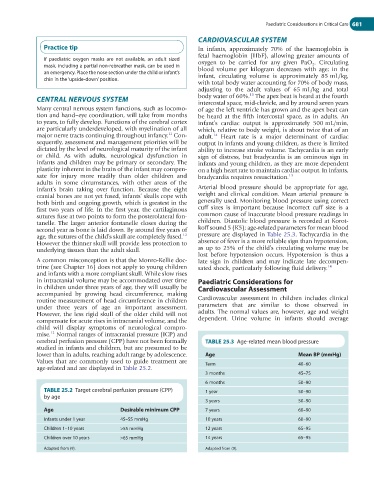
             cerebral perfusion pressure (CPP) have not been formally   TABLE 25.3  Age-related mean blood pressure
             studied in infants and children, but are presumed to be
             lower than in adults, reaching adult range by adolescence.   Age                      Mean BP (mmHg)
             Values  that  are  commonly  used  to  guide  treatment  are   Term                   40–60
             age-related and are displayed in Table 25.2.
                                                                    3 months                       45–75
                                                                    6 months                       50–90
               TABLE 25.2  Target cerebral perfusion pressure (CPP)   1 year                       50–90
               by age
                                                                    3 years                        50–90
               Age                      Desirable minimum CPP       7 years                        60–90
               Infants under 1 year     45–55 mmHg                  10 years                       60–90
               Children 1–10 years      >55 mmHg                    12 years                       65–95
               Children over 10 years   >65 mmHg                    14 years                       65–95
               Adapted from (9).                                    Adapted from (9).

