


Page 734 - ACCCN's Critical Care Nursing
P. 734
Pregnancy and Postpartum Considerations 711


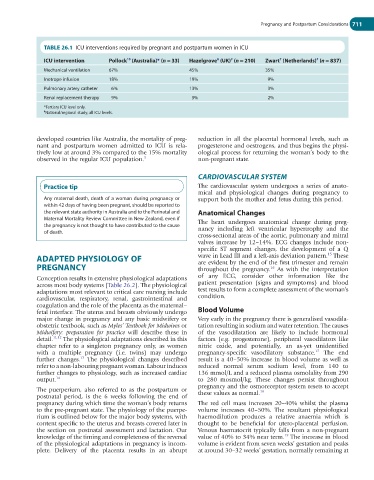
               TABLE 26.1  ICU interventions required by pregnant and postpartum women in ICU

                                                                        6
                                           10
               ICU intervention      Pollock  (Australia)* (n = 33)  Hazelgrove  (UK)  (n = 210)  Zwart  (Netherlands)  (n = 837)
                                                                                                         #
                                                                                            7
                                                                             #
               Mechanical ventilation  67%                     45%                      35%
               Inotrope infusion     18%                       19%                       9%
               Pulmonary artery catheter  6%                   13%                       3%
               Renal replacement therapy  9%                    3%                       2%
               *Tertiary ICU level only.
               # National/regional study, all ICU levels.


             developed countries like Australia, the mortality of preg-  reduction  in  all  the  placental  hormonal  levels,  such  as
             nant  and  postpartum  women  admitted  to  ICU  is  rela-  progesterone and oestrogens, and thus begins the physi-
             tively low at around 3% compared to the 15% mortality   ological process for returning the woman’s body to the
             observed in the regular ICU population. 3            non-pregnant state.

                                                                  CARDIOVASCULAR SYSTEM
               Practice tip                                       The  cardiovascular  system  undergoes  a  series  of  anato-
                                                                  mical  and  physiological  changes  during  pregnancy  to
               Any maternal death, death of a woman during pregnancy or   support both the mother and fetus during this period.
               within 42 days of having been pregnant, should be reported to
               the relevant state authority in Australia and to the Perinatal and   Anatomical Changes
               Maternal Mortality Review Committee in New Zealand, even if   The  heart  undergoes  anatomical  change  during  preg-
               the pregnancy is not thought to have contributed to the cause   nancy  including  left  ventricular  hypertrophy  and  the
               of death.
                                                                  cross-sectional areas of the aortic, pulmonary and mitral
                                                                  valves  increase  by  12–14%.  ECG  changes  include  non-
                                                                  specific  ST  segment  changes,  the  development  of  a  Q
                                                                                                            15
             ADAPTED PHYSIOLOGY OF                                wave in Lead III and a left-axis deviation pattern.  These
                                                                  are evident by the end of the first trimester and remain
             PREGNANCY                                            throughout  the  pregnancy.   As  with  the  interpretation
                                                                                         16
             Conception results in extensive physiological adaptations   of  any  ECG,  consider  other  information  like  the
             across most body systems (Table 26.2). The physiological   patient  presentation  (signs  and  symptoms)  and  blood
             adaptations most relevant to critical care nursing include   test results to form a complete assessment of the woman’s
             cardiovascular,  respiratory,  renal,  gastrointestinal  and   condition.
             coagulation and the role of the placenta as the maternal–
             fetal interface. The uterus and breasts obviously undergo   Blood Volume
             major change in pregnancy and any basic midwifery or   Very early in the pregnancy there is generalised vasodila-
             obstetric textbook, such as Myles’ Textbook for Midwives or   tation resulting in sodium and water retention. The causes
             Midwifery:  preparation  for  practice  will  describe  these  in   of  the  vasodilatation  are  likely  to  include  hormonal
             detail. 11,12  The physiological adaptations described in this   factors  (e.g.  progesterone),  peripheral  vasodilators  like
             chapter  refer  to  a  singleton  pregnancy  only,  as  women   nitric  oxide,  and  potentially,  an  as-yet  unidentified
             with  a  multiple  pregnancy  (i.e.  twins)  may  undergo   pregnancy-specific  vasodilatory  substance.   The  end
                                                                                                        17
             further  changes.   The  physiological  changes  described   result is a 40–50% increase in blood volume as well as
                           13
             refer to a non-labouring pregnant woman. Labour induces   reduced  normal  serum  sodium  level,  from  140  to
             further changes to physiology, such as increased cardiac   136 mmol/L and a reduced plasma osmolality from 290
             output. 14                                           to  280  mosmol/kg.  These  changes  persist  throughout
                                                                  pregnancy and the osmoreceptor system resets to accept
             The  puerperium,  also  referred  to  as  the  postpartum  or   these values as normal. 18
             postnatal  period,  is  the  6  weeks  following  the  end  of
             pregnancy during which time the woman’s body returns   The  red  cell  mass  increases  20–40%  whilst  the  plasma
             to the pre-pregnant state. The physiology of the puerpe-  volume  increases  40–50%.  The  resultant  physiological
             rium is outlined below for the major body systems, with   haemodilution  produces  a  relative  anaemia  which  is
             content specific to the uterus and breasts covered later in   thought  to  be  beneficial  for  utero-placental  perfusion.
             the section on postnatal assessment and lactation. Our   Venous haematocrit typically falls from a non-pregnant
                                                                                              19
             knowledge of the timing and completeness of the reversal   value of 40% to 34% near term.  The increase in blood
             of the physiological adaptations in pregnancy is incom-  volume is evident from seven weeks’ gestation and peaks
             plete.  Delivery  of  the  placenta  results  in  an  abrupt   at around 30–32 weeks’ gestation, normally remaining at

