


Page 737 - ACCCN's Critical Care Nursing
P. 737
714  S P E C I A LT Y   P R A C T I C E   I N   C R I T I C A L   C A R E

         renal complications of pregnancy and is associated with   Hepatobiliary Changes in Pregnancy
         the onset of preterm labour. 45
                                                              There is no significant increase in hepatic arterial blood
         The kidneys receive a proportion of the additional cardiac   flow  during  pregnancy,  despite  the  40–50%  increased
                                                                           51
         output resulting in a 30% increase in renal blood flow.   cardiac output.  There is, however, a doubling of blood-
                                                                                                    51
         The  glomerular  filtration  rate  (GFR)  increases  40–50%   flow to the liver supplied by the portal vein,  which may
         during the first trimester and then reduces slightly towards   have  an  impact  on  oral  medication  metabolism  in  the
                                   18
         the end of the third trimester.  The increase in GFR may   liver.  There  are  also  changes  in  other  hepatic  enzymes
         result  in  the  tubule  active  transport  systems  for  both   responsible for drug metabolism, resulting in a change
         glucose and proteins to be exhausted, with both glycos-  in  pharmacokinetics  of  some  medications,  e.g.  higher
         uria and proteinuria common in pregnancy. Glycosuria   plasma  levels  of  midazolam.  Serum  albumin  levels
         is not related to blood sugar levels and is unhelpful in   reduce to 30–40 g/L for the majority of pregnancy, with
         monitoring diabetes. Proteinuria, up to 300 mg per 24   levels as low as 25 g/L normal during the second post-
                                                                          46
         hours, is considered normal in pregnancy. Conversely, the   partum  week.   This  low  albumin  level  reduces  colloid
         high GFR results in lowered serum levels of both urea and   osmotic  pressure  that  contributes  to  the  dependent
         creatinine.  A  plasma  urea  level  exceeding  4.5 mmol/L   oedema, for example swollen ankles, that is common in
         and  plasma  creatinine  level  higher  than  75  µmol/L,   pregnancy.
         should be viewed as abnormal and indicative of potential   The  general  smooth  muscle  vasodilatation  affects  the
         renal  impairment. 18,46   There  is  conflicting  information   hepatobiliary  ducts,  resulting  in  sluggish  bile  motility
         regarding  normal  urine  output  during  pregnancy,  with   and delayed emptying of the gall bladder. These changes
         some studies suggesting no difference to that during non-  lead to an increased incidence of cholelithiasis and cho-
         pregnancy  and  others  reporting  an  increase  in  24-hour   lecystitis during pregnancy.
         urine volume after 12 weeks’ gestation. 45,47

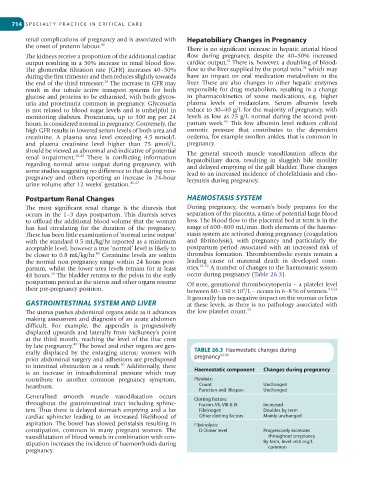
         Postpartum Renal Changes                             HAEMOSTASIS SYSTEM
         The  most  significant  renal  change  is  the  diuresis  that   During  pregnancy,  the  woman’s  body  prepares  for  the
         occurs in the 1–3 days postpartum. This diuresis serves   separation of the placenta, a time of potential large blood
         to offload the additional blood volume that the woman   loss. The blood flow to the placental bed at term is in the
         has  had  circulating  for  the  duration  of  the  pregnancy.   range of 600–800 mL/min. Both elements of the haemo-
         There has been little examination of ‘normal urine output’   stasis system are activated during pregnancy (coagulation
         with the standard 0.5 mL/kg/hr reported as a minimum   and  fibrinolysis),  with  pregnancy  and  particularly  the
         acceptable level, however a true ‘normal’ level is likely to   postpartum period associated with an increased risk of
         be closer to 0.8 mL/kg/hr.  Creatinine levels are within   thrombus formation. Thromboembolic events remain a
                                48
         the normal non-pregnancy range within 24 hours post-  leading  cause  of  maternal  death  in  developed  coun-
         partum, whilst the lower urea levels remain for at least   tries. 24,52  A number of changes to the haemostatic system
                  46
         48 hours.  The bladder returns to the pelvis in the early   occur during pregnancy (Table 26.3).
         postpartum period as the uterus and other organs resume   Of note, gestational thrombocytopenia – a platelet level
         their pre-pregnancy position.                        between 80–150 × 10 /L – occurs in 6–8 % of women. 53,54
                                                                                 9
                                                              It generally has no negative impact on the woman or fetus
         GASTROINTESTINAL SYSTEM AND LIVER                    at these levels, as there is no pathology associated with
         The uterus pushes abdominal organs aside as it advances   the low platelet count. 55
         making assessment and diagnosis of an acute abdomen
         difficult.  For  example,  the  appendix  is  progressively
         displaced upwards and laterally from McBurney’s point
         at the third month, reaching the level of the iliac crest
         by late pregnancy.  The bowel and other organs are gen-
                         49
         erally  displaced  by  the  enlarging  uterus;  women  with   TABLE 26.3  Haemostatic changes during
                                                                         56-58
         prior abdominal surgery and adhesions are predisposed   pregnancy
                                        50
         to intestinal obstruction as a result.  Additionally, there
         is  an  increase  in  intraabdominal  pressure  which  may    Haemostatic component  Changes during pregnancy
         contribute  to  another  common  pregnancy  symptom,    Platelets:
         heartburn.                                                Count               Unchanged
                                                                   Function and lifespan  Unchanged
         Generalised  smooth  muscle  vasodilatation  occurs     Clotting factors:
         throughout  the  gastrointestinal  tract  including  sphinc-    Factors VII, VIII & IX  Increased
         ters. Thus there is delayed stomach emptying and a lax     Fibrinogen         Doubles by term
         cardiac  sphincter  leading  to  an  increased  likelihood  of     Other clotting factors  Mainly unchanged
         aspiration. The bowel has slowed peristalsis resulting in   Fibrinolysis:
         constipation,  common  in  many  pregnant  women.  The     D-Dimer level      Progressively increases
         vasodilatation of blood vessels in combination with con-                        throughout pregnancy
         stipation increases the incidence of haemorrhoids during                      By term, level >0.5 mg/L
         pregnancy.                                                                      common

