


Page 735 - ACCCN's Critical Care Nursing
P. 735
712  S P E C I A LT Y   P R A C T I C E   I N   C R I T I C A L   C A R E

                                                              Heart Rate, Stroke Volume and
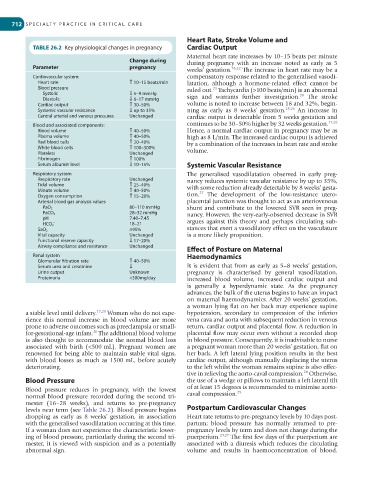
            TABLE 26.2  Key physiological changes in pregnancy  Cardiac Output
                                                              Maternal heart rate increases by 10–15 beats per minute
                                           Change during      during  pregnancy  with  an  increase  noted  as  early  as  5
            Parameter                      pregnancy          weeks’ gestation. 16,22  The increase in heart rate may be a
            Cardiovascular system:                            compensatory response related to the generalised vasodi-
              Heart rate                   ↑ 10–15 beats/min  latation,  although  a  hormone-related  effect  cannot  be
              Blood pressure                                  ruled out.  Tachycardia (>100 beats/min) is an abnormal
                                                                       23
                Systolic                   ↓ 5–9 mmHg                                              24
                Diastolic                  ↓ 6–17 mmHg        sign  and  warrants  further  investigation.   The  stroke
              Cardiac output               ↑ 30–50%           volume is noted to increase between 18 and 32%, begin-
              Systemic vascular resistance  ↓ up to 35%       ning  as  early  as  8  weeks’  gestation. 25,26   An  increase  in
              Central arterial and venous pressures  Unchanged  cardiac output is detectable from 5 weeks gestation and
            Blood and associated components:                  continues to be 30–50% higher by 32 weeks gestation. 17,26
              Blood volume                 ↑ 40–50%           Hence, a normal cardiac output in pregnancy may be as
              Plasma volume                ↑ 40–50%           high as 8 L/min. The increased cardiac output is achieved
              Red blood cells              ↑ 20–40%           by a combination of the increases in heart rate and stroke
              White blood cells            ↑ 100–300%         volume.
              Platelets                    Unchanged
              Fibrinogen                   ↑ 100%
              Serum albumin level          ↓ 10–15%           Systemic Vascular Resistance
            Respiratory system                                The  generalised  vasodilatation  observed  in  early  preg-
              Respiratory rate             Unchanged          nancy reduces systemic vascular resistance by up to 35%,
              Tidal volume                 ↑ 25–40%           with some reduction already detectable by 8 weeks’ gesta-
              Minute volume                ↑ 40–50%               27
              Oxygen consumption           ↑ 15–20%           tion.   The  development  of  the  low-resistance  utero-
              Arterial blood gas analysis values              placental junction was thought to act as an arteriovenous
                                           80–110 mmHg        shunt and contribute to the lowered SVR seen in preg-
                PaO 2
                                           28–32 mmHg
                PaCO 2                                        nancy. However, the very-early-observed decrease in SVR
                pH                         7.40–7.45
                   −                                          argues  against  this  theory  and  perhaps  circulating  sub-
                HCO 3                      18–21              stances that exert a vasodilatory effect on the vasculature
              SaO 2                        ≥95%
              Vital capacity               Unchanged          is a more likely proposition.
              Functional reserve capacity  ↓ 17–20%
              Airway compliance and resistance  Unchanged     Effect of Posture on Maternal
            Renal system                                      Haemodynamics
              Glomerular filtration rate   ↑ 40–50%
              Serum urea and creatinine    ↓                  It is evident that from as early as 5–8 weeks’ gestation,
              Urine output                 Unknown            pregnancy  is  characterised  by  general  vasodilatation,
              Proteinuria                  <300mg/day         increased  blood  volume,  increased  cardiac  output  and
                                                              is  generally  a  hyperdynamic  state.  As  the  pregnancy
                                                              advances, the bulk of the uterus begins to have an impact
                                                              on maternal haemodynamics. After 20 weeks’ gestation,
                                                              a woman lying flat on her back may experience supine
         a stable level until delivery. 17,20  Women who do not expe-  hypotension,  secondary  to  compression  of  the  inferior
         rience  this  normal  increase  in  blood  volume  are  more   vena cava and aorta with subsequent reduction in venous
         prone to adverse outcomes such as preeclampsia or small-   return, cardiac output and placental flow. A reduction in
                                21
         for-gestational-age infant.  The additional blood volume   placental flow may occur even without a recorded drop
         is also thought to accommodate the normal blood loss   in blood pressure. Consequently, it is inadvisable to nurse
         associated  with  birth  (<500 mL).  Pregnant  women  are   a pregnant woman more than 20 weeks’ gestation, flat on
         renowned for being able to maintain stable vital signs,   her back. A left lateral lying position results in the best
         with  blood  losses  as  much  as  1500 mL,  before  acutely   cardiac output, although manually displacing the uterus
         deteriorating.                                       to the left whilst the woman remains supine is also effec-
                                                                                                    28
                                                              tive in relieving the aorto-caval compression.  Otherwise,
         Blood Pressure                                       the use of a wedge or pillows to maintain a left lateral tilt
         Blood  pressure  reduces  in  pregnancy,  with  the  lowest   of at least 15 degrees is recommended to minimise aorto-
                                                                               29
         normal  blood  pressure  recorded  during  the  second  tri-  caval compression.
         mester  (16–28  weeks),  and  returns  to  pre-pregnancy
         levels near term (see Table 26.2). Blood pressure begins   Postpartum Cardiovascular Changes
         dropping  as  early  as  8  weeks’  gestation,  in  association   Heart rate returns to pre-pregnancy levels by 10 days post-
         with the generalised vasodilatation occurring at this time.   partum;  blood  pressure  has  normally  returned  to  pre-
         If a woman does not experience the characteristic lower-  pregnancy levels by term and does not change during the
         ing of blood pressure, particularly during the second tri-  puerperium. 23,27  The first few days of the puerperium are
         mester, it is viewed with suspicion and as a potentially   associated with a diuresis which reduces the circulating
         abnormal sign.                                       volume  and  results  in  haemoconcentration  of  blood.

