


Page 738 - ACCCN's Critical Care Nursing
P. 738
Pregnancy and Postpartum Considerations 715


                               Umbilical vein

                              Umbilical artery


                                  Main villus


                                    Septum


                                Maternal vein

                                   Decidua
                          Maternal spiral artery


                               Uterine muscle


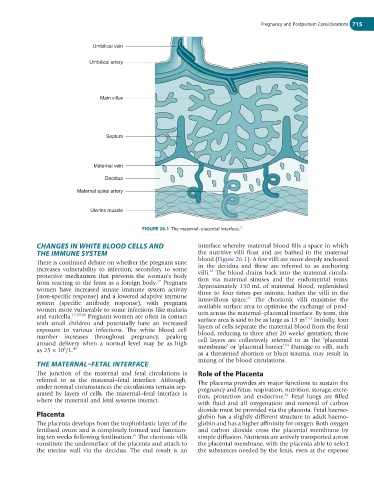
                                                FIGURE 26.1  The maternal–placental interface.
                                                                               11
             CHANGES IN WHITE BLOOD CELLS AND                     interface whereby maternal blood fills a space in which
             THE IMMUNE SYSTEM                                    the  nutritive  villi  float  and  are  bathed  in  the  maternal
             There is continued debate on whether the pregnant state   blood (Figure 26.1). A few villi are more deeply anchored
             increases  vulnerability  to  infection,  secondary  to  some   in  the  decidua  and  these  are  referred  to  as  anchoring
                                                                      61
             protective  mechanism  that  prevents  the  woman’s  body   villi.  The blood drains back into the maternal circula-
                                                    17
             from reacting to the fetus as a foreign body.  Pregnant   tion  via  maternal  sinuses  and  the  endometrial  veins.
             women  have  increased  innate  immune  system  activity   Approximately  150 mL  of  maternal  blood,  replenished
             (non-specific response) and a lowered adaptive immune   three  to  four  times  per  minute,  bathes  the  villi  in  the
                                                                                  61
             system  (specific  antibody  response),  with  pregnant   intervillous  space.   The  chorionic  villi  maximise  the
             women more vulnerable to some infections like malaria   available surface area to optimise the exchange of prod-
             and varicella. 17,59,60  Pregnant women are often in contact   ucts across the maternal–placental interface. By term, this
                                                                                                     2 62
             with  small  children  and  potentially  have  an  increased   surface area is said to be as large as 13 m .  Initially, four
             exposure  to  various  infections.  The  white  blood  cell   layers of cells separate the maternal blood from the fetal
             number  increases  throughout  pregnancy,  peaking    blood, reducing to three after 20 weeks’ gestation; these
             around  delivery  when  a  normal  level  may  be  as  high    cell  layers  are  collectively  referred  to  as  the  ‘placental
                                                                                              63
                      9
             as 25 × 10 /L. 46                                    membrane’ or ‘placental barrier’.  Damage to villi, such
                                                                  as a threatened abortion or blunt trauma, may result in
             THE MATERNAL–FETAL INTERFACE                         mixing of the blood circulations.
             The  junction  of  the  maternal  and  fetal  circulations  is   Role of the Placenta
             referred  to  as  the  maternal–fetal  interface.  Although,   The placenta provides six major functions to sustain the
             under normal circumstances the circulations remain sep-  pregnancy and fetus: respiration, nutrition, storage, excre-
             arated  by  layers  of  cells,  the  maternal–fetal  interface  is   tion,  protection  and  endocrine.   Fetal  lungs  are  filled
                                                                                              61
             where the maternal and fetal systems interact.
                                                                  with  fluid  and  all  oxygenation  and  removal  of  carbon
                                                                  dioxide must be provided via the placenta. Fetal haemo-
             Placenta                                             globin has a slightly different structure to adult haemo-
             The placenta develops from the trophoblastic layer of the   globin and has a higher affininity for oxygen. Both oxygen
             fertilised ovum and is completely formed and function-  and  carbon  dioxide  cross  the  placental  membrane  by
                                             61
             ing ten weeks following fertilisation.  The chorionic villi   simple diffusion. Nutrients are actively transported across
             constitute the undersurface of the placenta and attach to   the placental membrane, with the placenta able to select
             the  uterine  wall  via  the  decidua.  The  end  result  is  an   the substances needed by the fetus, even at the expense

