


Page 752 - ACCCN's Critical Care Nursing
P. 752
Pregnancy and Postpartum Considerations 729

                                                                                                             24
                pregnant  women  with  mechanical  valves  experience   presentation  to  the  emergency  department.   The
                unacceptably  high  rates  of  valve  thrombosis  and   ‘story’ of the injury should be considered in relation
                embolism  when  switched  to  heparin,  and  so  many   to  the  presenting  injury  and  likely  mechanism  of
                cardiologists  consider  the  risks  associated  with  the   injury;  another  potential  sign  is  when  the  woman
                continued use of warfarin in pregnancy to be lower   appears  evasive  or  reluctant  to  speak  or  disagree  in
                                                                                       24
                than the risks of stopping it. Therefore a regimen that   front  of  her  partner.   Pregnancy-related  violence  is
                balances the risk of thrombosis with that of fetal loss   associated  with  low  birth  weight  babies,  premature
                and  risk  of  haemorrhage  should  be  implemented,   labour and fetal trauma. 162
                with  some  variation  stopping  warfarin  for  the     l  Musculoskeletal  injuries:  pregnancy  hormones,  pre-
                whole first trimester or from 6–12 weeks gestation and   dominantly  relaxin,  oestrogen  and  progesterone,
                then  resumed  until  close  to  delivery;  replacing     affect joints and ligaments making them more lax and
                warfarin with unfractionated or low molecular weight   pliable.  This  increased  joint  mobility  explains  why
                heparin  for  the  whole  pregnancy  or  continuing     pregnant women are more likely to experience joint
                warfarin throughout pregnancy and replacing it with   injury, pelvic instability, back pain and strained and
                heparin for delivery only. Appropriate dosing sched-  dislocated  joints,  and  combined  with  the  altered
                ules for heparin have not been confirmed with low-   centre of balance with the advancing uterus, explains
                dose heparin considered inadequate and high doses    why  pregnant  women  readily  fall  off  ladders,  for
                of unfractionated heparin not researched. 157        example when decorating the nursery.
             l  Secondary  prevention  of  rheumatic  heart  disease:   l  Motor vehicle trauma: is the most common reason for
                monthly IM penicillin, e.g. 1,200,000 units of benzyl   a pregnant woman to present to an emergency depart-
                penicillin,  to  minimise  repeat  acute  rheumatic  fever   ment  with  trauma.  Unfortunately,  some  pregnant
                and associated further valve degeneration. 158       women believe there is no legal requirement to wear
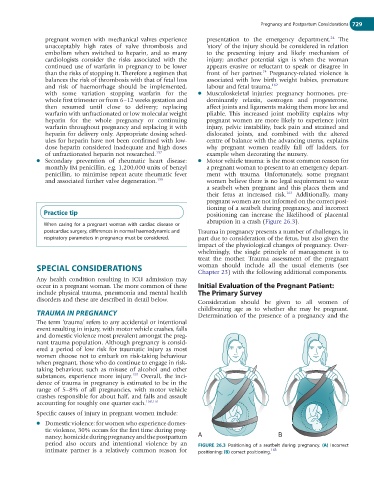
                                                                     a  seatbelt  when  pregnant  and  this  places  them  and
                                                                     their  fetus  at  increased  risk. 163   Additionally,  many
                                                                     pregnant women are not informed on the correct posi-
                                                                     tioning of a seatbelt during pregnancy, and incorrect
               Practice tip                                          positioning  can  increase  the  likelihood  of  placental
               When  caring  for  a  pregnant  woman  with  cardiac  disease  or   abruption in a crash (Figure 26.3).
               postcardiac surgery, differences in normal haemodynamic and   Trauma in pregnancy presents a number of challenges, in
               respiratory parameters in pregnancy must be considered.  part due to consideration of the fetus, but also given the
                                                                  impact of the physiological changes of pregnancy. Over-
                                                                  whelmingly,  the  single  principle  of  management  is  to
                                                                  treat  the  mother.  Trauma  assessment  of  the  pregnant
             SPECIAL CONSIDERATIONS                               woman  should  include  all  the  usual  elements  (see
                                                                  Chapter 23) with the following additional components.
             Any  health  condition  resulting  in  ICU  admission  may
             occur in a pregnant woman. The more common of these   Initial Evaluation of the Pregnant Patient:
             include physical trauma, pneumonia and mental health   The Primary Survey
             disorders and these are described in detail below.   Consideration  should  be  given  to  all  women  of
                                                                  childbearing  age  as  to  whether  she  may  be  pregnant.
             TRAUMA IN PREGNANCY                                  Determination  of  the  presence  of  a  pregnancy  and  the
             The term ‘trauma’ refers to any accidental or intentional
             event resulting in injury, with motor vehicle crashes, falls
             and domestic violence most prevalent amongst the preg-
             nant trauma population. Although pregnancy is consid-
             ered  a  period  of  low  risk  for  traumatic  injury  as  most
             women choose not to embark on risk-taking behaviour
             when pregnant, those who do continue to engage in risk-
             taking  behaviour,  such  as  misuse  of  alcohol  and  other
             substances, experience more injury. 159  Overall, the inci-
             dence of trauma in pregnancy is estimated to be in the
             range  of  5–8%  of  all  pregnancies,  with  motor  vehicle
             crashes responsible for about half, and falls and assault
             accounting for roughly one quarter each. 160,161
             Specific causes of injury in pregnant women include:
             l  Domestic violence: for women who experience domes-
                tic violence, 30% occurs for the first time during preg-
                nancy; homicide during pregnancy and the postpartum   A                     B
                period  also  occurs  and  intentional  violence  by  an    FIGURE  26.3  Positioning  of  a  seatbelt  during  pregnancy.  (A)  Incorrect
                intimate  partner  is  a  relatively  common  reason  for   positioning; (B) correct positioning. 163

