


Page 750 - ACCCN's Critical Care Nursing
P. 750
Pregnancy and Postpartum Considerations 727


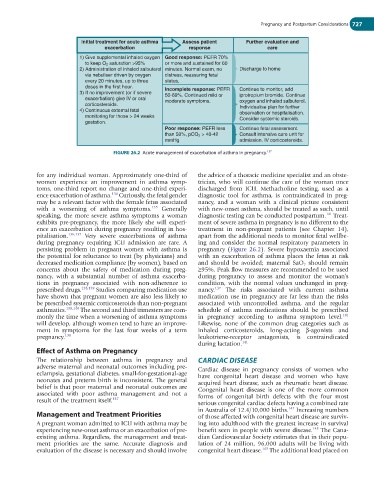
                            Initial treatment for acute asthma  Assess patient    Further evaluation and
                                   exacerbation                response                 care
                           1) Give supplemental inhaled oxygen  Good response: PEFR 70%
                               to keep O 2  saturation >95%  or more and sustained for 60
                           2) Administration of inhaled salbuterol minutes. Normal exam, no  Discharge to home
                               via nebuliser driven by oxygen  distress, reassuring fetal
                               every 20 minutes, up to three  status.
                               doses in the first hour.  Incomplete response: PEFR  Continue to monitor, add
                           3) If no improvement (or if severe  50-69%. Continued mild or  iprotropium bromide. Continue
                               exacerbation) give IV or oral  moderate symptoms.  oxygen and inhaled salbuterol.
                               corticosteroids.                                Individualise plan for further
                           4) Continuous external fetal                        observation or hospitalisation.
                               monitoring for those > 24 weeks                 Consider systemic steroids.
                               gestation.
                                                       Poor response: PEFR less  Continue fetal assessment.
                                                       than 50%, pCO 2  > 40-42  Consult intensive care unit for
                                                       mmHg                    admission. IV corticosteroids.
                                      FIGURE 26.2  Acute management of exacerbation of asthma in pregnancy.
                                                                                        137


             for  any  individual  woman.  Approximately  one-third  of   the advice of a thoracic medicine specialist and an obste-
             women  experience  an  improvement  in  asthma  symp-  trician, who will continue the care of the woman once
             toms, one-third report no change and one-third experi-  discharged  from  ICU.  Methacholine  testing,  used  as  a
             ence exacerbation of asthma. 134  Curiously, the fetal gender   diagnostic  tool  for  asthma,  is  contraindicated  in  preg-
             may be a relevant factor with the female fetus associated   nancy,  and  a  woman  with  a  clinical  picture  consistent
             with  a  worsening  of  asthma  symptoms. 135   Generally   with new-onset asthma, should be treated as such, until
                                                                                                            141
             speaking,  the  more  severe  asthma  symptoms  a  woman   diagnostic testing can be conducted postpartum.  Treat-
             exhibits  pre-pregnancy,  the  more  likely  she  will  experi-  ment of severe asthma in pregnancy is no different to the
             ence an exacerbation during pregnancy resulting in hos-  treatment  in  non-pregnant  patients  (see  Chapter  14),
             pitalisation. 136,137   Very  severe  exacerbations  of  asthma   apart from the additional needs to monitor fetal wellbe-
             during  pregnancy  requiring  ICU  admission  are  rare.  A   ing  and  consider  the  normal  respiratory  parameters  in
             persisting  problem  in  pregnant  women  with  asthma  is   pregnancy  (Figure  26.2).  Severe  hypoxaemia  associated
             the potential for reluctance to treat (by physicians) and   with an exacerbation of asthma places the fetus at risk
             decreased medication compliance (by women), based on   and  should  be  avoided;  maternal  SaO 2   should  remain
             concerns  about  the  safety  of  medication  during  preg-  ≥95%. Peak flow measures are recommended to be used
             nancy,  with  a  substantial  number  of  asthma  exacerba-  during  pregnancy  to  assess  and  monitor  the  woman’s
             tions  in  pregnancy  associated  with  non-adherence  to   condition,  with  the  normal  values  unchanged  in  preg-
             prescribed drugs. 138,139  Studies comparing medication use   nancy. 137   The  risks  associated  with  current  asthma
             have shown that pregnant women are also less likely to   medication use in pregnancy are far less than the risks
             be prescribed systemic corticosteroids than non-pregnant   associated  with  uncontrolled  asthma,  and  the  regular
             asthmatics. 138,140  The second and third trimesters are com-  schedule  of  asthma  medications  should  be  prescribed
                                                                                                                 141
             monly the time when a worsening of asthma symptoms   in  pregnancy  according  to  asthma  symptom  level.
             will develop, although women tend to have an improve-  Likewise, none of the common drug categories such as
             ment  in  symptoms  for  the  last  four  weeks  of  a  term   inhaled  corticosteroids,  long-acting  β-agonists  and
             pregnancy. 138                                       leukotriene-receptor  antagonists,  is  contraindicated
                                                                  during lactation. 141
             Effect of Asthma on Pregnancy

             The  relationship  between  asthma  in  pregnancy  and   CARDIAC DISEASE
             adverse maternal and neonatal outcomes including pre-  Cardiac  disease  in  pregnancy  consists  of  women  who
             eclampsia, gestational diabetes, small-for-gestational-age   have  congenital  heart  disease  and  women  who  have
             neonates and preterm birth is inconsistent. The general   acquired heart disease, such as rheumatic heart disease.
             belief is that poor maternal and neonatal outcomes are   Congenital  heart  disease  is  one  of  the  more  common
             associated  with  poor  asthma  management  and  not  a   forms  of  congenital  birth  defects  with  the  four  most
             result of the treatment itself. 137
                                                                  serious congenital cardiac defects having a combined rate
                                                                                               142
                                                                  in Australia of 12.4/10,000 births.  Increasing numbers
             Management and Treatment Priorities                  of those affected with congenital heart disease are surviv-
             A pregnant woman admitted to ICU with asthma may be   ing into adulthood with the greatest increase in survival
             experiencing new-onset asthma or an exacerbation of pre-  benefit seen in people with severe disease. 143  The Cana-
             existing asthma. Regardless, the management and treat-  dian Cardiovascular Society estimates that in their popu-
             ment  priorities  are  the  same.  Accurate  diagnosis  and   lation  of  24  million,  96,000  adults  will  be  living  with
             evaluation of the disease is necessary and should involve   congenital heart disease. 143  The additional load placed on

