


Page 773 - ACCCN's Critical Care Nursing
P. 773
750  S P E C I A LT Y   P R A C T I C E   I N   C R I T I C A L   C A R E


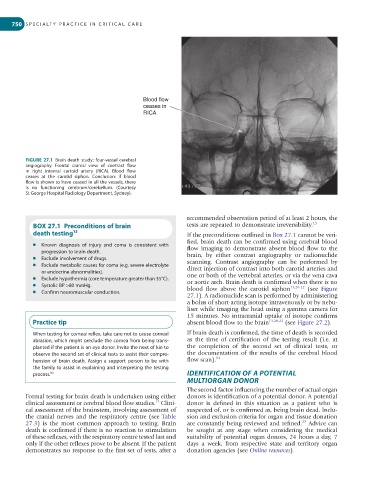
                                                Blood flow
                                                ceases in
                                                RICA


         FIGURE 27.1  Brain  death  study:  four-vessel  cerebral
         angiography.  Frontal  cranial  view  of  contrast  flow
         in  right  internal  cartoid  artery  (RICA).  Blood  flow
         ceases  at  the  carotid  siphon.  Conclusion:  if  blood
         flow is shown to have ceased in all the vessels, there
         is  no  functioning  cerebrum/cerebellum.  (Courtesy
         St George Hospital Radiology Department, Sydney).


                                                              recommended observation period of at least 2 hours, the
            BOX 27.1  Preconditions of brain                  tests are repeated to demonstrate irreversibility. 13
            death testing 13                                  If the preconditions outlined in Box 27.1 cannot be veri-
                                                              fied, brain death can be confirmed using cerebral blood
            l  Known  diagnosis  of  injury  and  coma  is  consistent  with   flow  imaging  to  demonstrate  absent  blood  flow  to  the
               progression to brain death.                    brain,  by  either  contrast  angiography  or  radionuclide
            l  Exclude involvement of drugs.                  scanning.  Contrast  angiography  can  be  performed  by
            l  Exclude metabolic causes for coma (e.g. severe electrolyte   direct injection of contrast into both carotid arteries and
               or endocrine abnormalities).                   one or both of the vertebral arteries, or via the vena cava
            l  Exclude hypothermia (core temperature greater than 35°C).  or aortic arch. Brain death is confirmed when there is no
            l  Systolic BP >80 mmHg.                          blood  flow  above  the  carotid  siphon 13,20-22   (see  Figure
            l  Confirm neuromuscular conduction.
                                                              27.1). A radionuclide scan is performed by administering
                                                              a bolus of short-acting isotope intravenously or by nebu-
                                                              liser while imaging the head using a gamma camera for
                                                              15 minutes. No intracranial uptake of isotope confirms
            Practice tip                                      absent blood flow to the brain 13,20-22  (see Figure 27.2).
            When testing for corneal reflex, take care not to cause corneal   If brain death is confirmed, the time of death is recorded
            abrasion, which might preclude the cornea from being trans-  as  the  time  of  certification  of  the  testing  result  (i.e.  at
            planted if the patient is an eye donor. Invite the next of kin to   the  completion  of  the  second  set  of  clinical  tests,  or
            observe the second set of clinical tests to assist their compre-  the documentation of the results of the cerebral blood
            hension  of  brain  death.  Assign  a  support  person  to  be  with     flow scan). 13
            the family to assist in explaining and interpreting the testing
            process. 84                                       IDENTIFICATION OF A POTENTIAL
                                                              MULTIORGAN DONOR
                                                              The second factor influencing the number of actual organ
         Formal testing for brain death is undertaken using either   donors is identification of a potential donor. A potential
                                                    13
         clinical assessment or cerebral blood flow studies.  Clini-  donor  is  defined  in  this  situation  as  a  patient  who  is
         cal assessment of the brainstem, involving assessment of   suspected of, or is confirmed as, being brain dead. Inclu-
         the  cranial  nerves  and  the  respiratory  centre  (see  Table   sion and exclusion criteria for organ and tissue donation
                                                                                                    23
         27.3)  is  the  most  common  approach  to  testing.  Brain   are constantly being reviewed and refined.  Advice can
         death is confirmed if there is no reaction to stimulation   be  sought  at  any  stage  when  considering  the  medical
         of these reflexes, with the respiratory centre tested last and   suitability of potential organ donors, 24 hours a day, 7
         only if the other reflexes prove to be absent. If the patient   days  a  week,  from  respective  state  and  territory  organ
         demonstrates no response to the first set of tests, after a   donation agencies (see Online resources).

