


Page 778 - ACCCN's Critical Care Nursing
P. 778
Organ Donation and Transplantation  755

             CULTURAL COMPETENCE
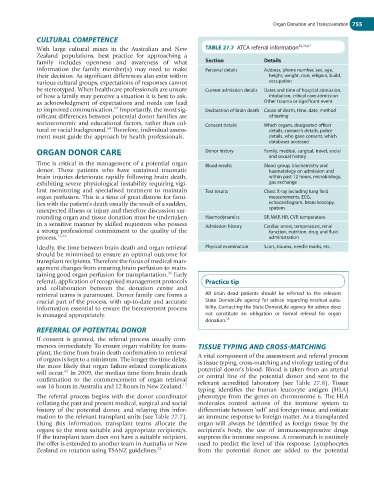
             With  large  cultural  mixes  in  the  Australian  and  New   TABLE 27.7  ATCA referral information 58,76,87
             Zealand  populations,  best  practice  for  approaching  a
             family  includes  openness  and  awareness  of  what    Section           Details
             information  the  family  member(s)  may  need  to  make   Personal details  Address, phone number, sex, age,
             their decision. As significant differences also exist within                height, weight, race, religion, build,
             various cultural groups, expectations of responses cannot                   occupation
             be stereotyped. When healthcare professionals are unsure   Current admission details  Dates and time of hospital admission,
             of how a family may perceive a situation it is best to ask,                 intubation, critical care admission
             as acknowledgment of expectations and needs can lead                      Other trauma or significant event
                                      63
             to improved communication.  Importantly, the most sig-  Declaration of brain death  Cause of death, time, date, method
             nificant differences between potential donor families are                   of testing
             socioeconomic and educational factors, rather than cul-  Consent details  Which organs, designated officer
             tural or racial background.  Therefore, individual assess-                  details, coroner’s details, police
                                    64
             ment must guide the approach by health professionals.                       details, who gave consent, which
                                                                                         databases accessed
             ORGAN DONOR CARE                                       Donor history      Family, medical, surgical, travel, social
                                                                                         and sexual history
             Time is critical in the management of a potential organ   Blood results   Blood group, biochemistry and
             donor.  Those  patients  who  have  sustained  traumatic                    haematology on admission and
             brain injuries deteriorate rapidly following brain death,                   within past 12 hours, microbiology,
             exhibiting severe physiological instability requiring vigi-                 gas exchange
             lant  monitoring  and  specialised  treatment  to  maintain   Test results  Chest X-ray including lung field
             organ perfusion. This is a time of great distress for fami-                 measurements, ECG,
             lies with the patient’s death usually the result of a sudden,               echocardiogram, bronchoscopy,
             unexpected illness or injury and therefore discussion sur-                  sputum
             rounding organ and tissue donation must be undertaken   Haemodynamics     BP, MAP, HR, CVP, temperature
             in a sensitive manner by skilled requestors who possess   Admission history  Cardiac arrest, temperature, renal
             a strong professional commitment to the quality of the                      function, nutrition, drug and fluid
             process. 13,36                                                              administration
             Ideally, the time between brain death and organ retrieval   Physical examination  Scars, trauma, needle marks, etc.
             should be minimised to ensure an optimal outcome for
             transplant recipients. Therefore the focus of medical man-
             agement changes from ensuring brain perfusion to main-
                                                        36
             taining good organ perfusion for transplantation.  Early
             referral, application of recognised management protocols   Practice tip
             and  collaboration  between  the  donation  centre  and
             retrieval teams is paramount. Donor family care forms a   All  brain  dead  patients  should  be  referred  to  the  relevant
             crucial part of the process, with up-to-date and accurate   State  DonateLife  agency  for  advice  regarding  medical  suita-
             information essential to ensure the bereavement process   bility. Contacting the State DonateLife agency for advice does
             is managed appropriately.                              not  constitute  an  obligation  or  formal  referral  for  organ
                                                                    donation. 58
             REFERRAL OF POTENTIAL DONOR
             If  consent  is  granted,  the  referral  process  usually  com-
             mences immediately. To ensure organ viability for trans-  TISSUE TYPING AND CROSS-MATCHING
             plant, the time from brain death confirmation to retrieval
             of organs is kept to a minimum. The longer the time delay,   A vital component of the assessment and referral process
             the more likely that organ failure-related complications   is tissue typing, cross-matching and virology testing of the
             will occur.  In 2009, the median time from brain death   potential donor’s blood. Blood is taken from an arterial
                      65
             confirmation  to  the  commencement  of  organ  retrieval   or  central  line  of  the  potential  donor  and  sent  to  the
             was 16 hours in Australia and 12 hours in New Zealand. 17  relevant  accredited  laboratory  (see  Table  27.8).  Tissue
                                                                  typing  identifies  the  human  leucocyte  antigen  (HLA)
             The  referral  process  begins  with  the  donor  coordinator   phenotype from the genes on chromosome 6. The HLA
             collating the past and present medical, surgical and social   molecules  control  actions  of  the  immune  system  to
             history  of  the  potential  donor,  and  relaying  this  infor-  differentiate between ‘self ’ and foreign tissue, and initiate
             mation to the relevant transplant units (see Table 27.7).   an immune response to foreign matter. As a transplanted
             Using  this  information,  transplant  teams  allocate  the   organ  will  always  be  identified  as  foreign  tissue  by  the
             organs to the most suitable and appropriate recipient/s.   recipient’s  body,  the  use  of  immunosuppressive  drugs
             If the transplant team does not have a suitable recipient,   suppress the immune response. A crossmatch is routinely
             the offer is extended to another team in Australia or New   used to predict the level of this response. Lymphocytes
             Zealand on rotation using TSANZ guidelines. 23       from  the  potential  donor  are  added  to  the  potential

