


Page 774 - ACCCN's Critical Care Nursing
P. 774
Organ Donation and Transplantation  751


               TABLE 27.3  Clinical brain death testing 13,38

               Test            Cranial nerves/neurological function Test technique          Outcome
               1. Response to   Trigeminal V (sensory), Facial VII (motor)  Stimulus within the cranial nerve   If reflex is absent, the patient
                 painful stimuli                               distribution (e.g. firm pressure over   will not grimace or react.
                                                               supraorbital region)
               2. Pupillary response  Optic II, Oculomotor III  Using torch                 If reflex is absent, the pupils
                 to light                                                                    are fixed: may or may not be
                                                                                             dilated.
               3. Corneal reflex  Trigeminal V (sensory), Facial VII (motor)  Using wisp of cotton wool to touch the   If the reflex is absent, the eyes
                                                               cornea                        will not react or blink.
               4. Gag reflex   Glossopharyngeal IX, Vagus X   Using a tongue depressor on the   If reflex is absent, there is no
                                                               oropharynx or moving ETT      gag or pharyngeal response.
               5. Cough reflex  Glossopharyngeal IX, Vagus X  Using suction catheter down ETT to   If reflex is absent, there is no
                                                               deliberately stimulate the carina  cough response.
               6. Oculovestibular   Vestibulocochlear VII, Oculomotor III,   Checking first that both tympanic   If reflex is absent, the eyes
                 reflex         Abducens VI                    membranes are intact or not   remain fixed rather than
                                                               obstructed; then slowly irrigating both   deviating towards the
                                                               ears with 50 mL iced water while eyes   stimulus.
                                                               are held open
               7. Apnoea test  Medullar respiratory centre    Last test to be performed when all other   The period of time
                                                               reflexes have proven to be absent.    disconnected from the
                                                               The patient is preoxygenated on 100%   ventilator must be long
                                                               O 2 , an ABG analysis is performed to   enough for the arterial
                                                               ascertain the baseline CO 2 , then   carbon monoxide level to
                                                               the patient is disconnected from   rise to a threshold high
                                                               mechanical ventilation but supplied   enough to normally
                                                               with oxygen via catheter or T piece;    stimulate respiration, i.e. an
                                                               the patient is observed for signs of   arterial CO 2  >60 mmHg and
                                                               respiratory effort            an arterial pH of <7.30.
               8. Oculocephalic   Ocular function and internuclear pathway   Although not a formal component of   If the reflex is absent, the eyes
                 reflex (doll’s eyes)  in brainstem for Cranial Nerves III, IV, VI;   brain death testing, this reflex may be   will move with the head and
                                labyrinthine semicircular canals, otoliths   tested as routine practice. The test must   do not move within their
                                and neck muscle proprioceptors  not be performed if an unstable   orbit, indicating significant
                                                               cervical spine is suspected. Holding the   brainstem injury.
                                                               eyes open, rotate the head from side to
                                                               side, observing the position of the eyes.


                                                                                                        No blood
                                                                                                        flow beyond
                                                                                                        carotid
                                                                                                        arteries


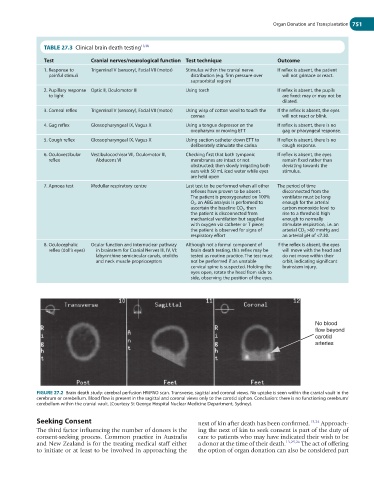
             FIGURE 27.2  Brain death study: cerebral perfusion HMPAO scan. Transverse, sagittal and coronal views. No uptake is seen within the cranial vault in the
             cerebrum or cerebellum. Blood flow is present in the sagittal and coronal views only to the carotid siphon. Conclusion: there is no functioning cerebrum/
             cerebellum within the cranial vault. (Courtesy St George Hospital Nuclear Medicine Department, Sydney).

             Seeking Consent                                      next of kin after death has been confirmed. 13,24  Approach-
             The third factor influencing the number of donors is the   ing the next of kin to seek consent is part of the duty of
             consent-seeking  process.  Common  practice  in  Australia   care to patients who may have indicated their wish to be
             and New Zealand is for the treating medical staff either   a donor at the time of their death. 13,25,26  The act of offering
             to initiate or at least to be involved in approaching the   the option of organ donation can also be considered part

