


Page 776 - ACCCN's Critical Care Nursing
P. 776
Organ Donation and Transplantation  753


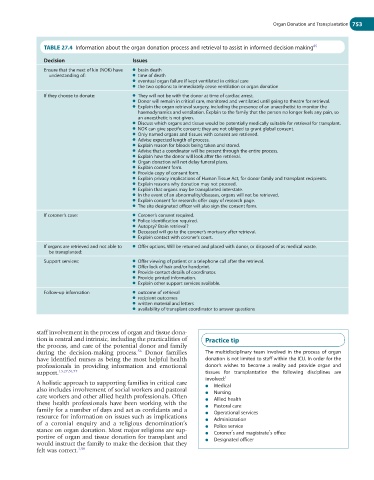
               TABLE 27.4  Information about the organ donation process and retrieval to assist in informed decision making 85

               Decision                     Issues
               Ensure that the next of kin (NOK) have   l  brain death
                 understanding of:          l  time of death
                                            l  eventual organ failure if kept ventilated in critical care
                                            l  the two options: to immediately cease ventilation or organ donation
               If they choose to donate:    l  They will not be with the donor at time of cardiac arrest.
                                            l  Donor will remain in critical care, monitored and ventilated until going to theatre for retrieval.
                                            l  Explain the organ retrieval surgery, including the presence of an anaesthetist to monitor the
                                              haemodynamics and ventilation. Explain to the family that the person no longer feels any pain, so
                                              an anaesthetic is not given.
                                            l  Discuss which organs and tissue would be potentially medically suitable for retrieval for transplant.
                                            l  NOK can give specific consent; they are not obliged to grant global consent.
                                            l  Only named organs and tissues with consent are retrieved.
                                            l  Advise expected length of process.
                                            l  Explain reason for bloods being taken and stored.
                                            l  Advise that a coordinator will be present through the entire process.
                                            l  Explain how the donor will look after the retrieval.
                                            l  Organ donation will not delay funeral plans.
                                            l  Explain consent form.
                                            l  Provide copy of consent form.
                                            l  Explain privacy implications of Human Tissue Act, for donor family and transplant recipients.
                                            l  Explain reasons why donation may not proceed.
                                            l  Explain that organs may be transplanted interstate.
                                            l  In the event of an abnormality/diseases, organs will not be retrieved.
                                            l  Explain consent for research: offer copy of research page.
                                            l  The site designated officer will also sign the consent form.
               If coroner’s case:           l  Coroner’s consent required.
                                            l  Police identification required.
                                            l  Autopsy? Brain retrieval?
                                            l  Deceased will go to the coroner’s mortuary after retrieval.
                                            l  Explain contact with coroner’s court.
               If organs are retrieved and not able to   l  Offer options. Will be returned and placed with donor, or disposed of as medical waste.
                 be transplanted:
               Support services:            l  Offer viewing of patient or a telephone call after the retrieval.
                                            l  Offer lock of hair and/or handprint.
                                            l  Provide contact details of coordinator.
                                            l  Provide printed information.
                                            l  Explain other support services available.
               Follow-up information        l  outcome of retrieval
                                            l  recipient outcomes
                                            l  written material and letters
                                            l  availability of transplant coordinator to answer questions


             staff involvement in the process of organ and tissue dona-
             tion is central and intrinsic, including the practicalities of   Practice tip
             the process, and care of the potential donor and family
                                              56
             during  the  decision-making  process.   Donor  families   The  multidisciplinary  team  involved  in  the  process  of  organ
             have identified nurses as being the most helpful health   donation is not limited to staff within the ICU. In order for the
             professionals  in  providing  information  and  emotional   donor’s  wishes  to  become  a  reality  and  provide  organ  and
             support. 13,27,51,57                                   tissues  for  transplantation  the  following  disciplines  are
                                                                    involved: 1
             A holistic approach to supporting families in critical care   l  Medical
             also includes involvement of social workers and pastoral   l  Nursing
             care workers and other allied health professionals. Often   l  Allied health
             these  health  professionals  have  been  working  with  the   l  Pastoral care
             family for a number of days and act as confidants and a   l  Operational services
             resource for information on issues such as implications   l  Administration
             of  a  coronial  enquiry  and  a  religious  denomination’s   l  Police service
             stance on organ donation. Most major religions are sup-  l  Coroner’s and magistrate’s office
             portive of organ and tissue donation for transplant and   l  Designated officer
             would instruct the family to make the decision that they
             felt was correct. 1,58

