


Page 88 - ACCCN's Critical Care Nursing
P. 88
Recovery and Rehabilitation 65


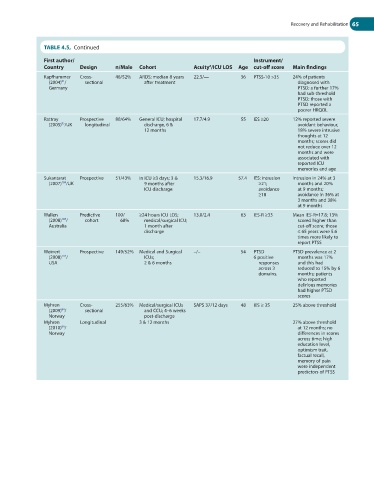
               TABLE 4.5,  Continued

               First author/                                                        Instrument/
                                                                      a
               Country     Design      n/Male  Cohort           Acuity /ICU LOS  Age  cut-off score  Main findings
               Kapfhammer   Cross-     46/52%  ARDS; median 8 years   22.5/—    36  PTSS-10 >35  24% of patients
                 (2004) /    sectional          after treatment                                   diagnosed with
                     81
                 Germany                                                                          PTSD; a further 17%
                                                                                                  had sub-threshold
                                                                                                  PTSD; those with
                                                                                                  PTSD reported a
                                                                                                  poorer HRQOL
               Rattray     Prospective   80/64%  General ICU; hospital   17.7/4.9  55  IES ≥20   12% reported severe
                 (2005) /UK  longitudinal       discharge, 6 &                                    avoidant behaviour,
                     85
                                                12 months                                         18% severe intrusive
                                                                                                  thoughts at 12
                                                                                                  months; scores did
                                                                                                  not reduce over 12
                                                                                                  months and were
                                                                                                  associated with
                                                                                                  reported ICU
                                                                                                  memories and age
               Sukantarat   Prospective  51/43%  In ICU ≥3 days; 3 &   15.3/16.9  57.4  IES: intrusion   Intrusion in 24% at 3
                 (2007) /UK                     9 months after                        ≥21;        months and 20%
                     184
                                                ICU discharge                         avoidance   at 9 months;
                                                                                      ≥18         avoidance in 36% at
                                                                                                  3 months and 38%
                                                                                                  at 9 months
               Wallen      Predictive   100/   ≥24 hours ICU LOS;   13.0/2.4    63  IES-R ≥33    Mean IES-R=17.8; 13%
                     185
                 (2008) /    cohort     68%     medical/surgical ICU;                             scored higher than
                 Australia                      1 month after                                     cut-off score; those
                                                discharge                                         ≤ 65 years were 5.6
                                                                                                  times more likely to
                                                                                                  report PTSS
               Weinert     Prospective  149/52%  Medical and Surgical   –/–     54  PTSD         PTSD prevalence at 2
                     105
                 (2008) /                       ICUs;                               6 positive    months was 17%
                 USA                            2 & 6 months                          responses   and this had
                                                                                      across 3    reduced to 15% by 6
                                                                                      domains.    months; patients
                                                                                                  who reported
                                                                                                  delirious memories
                                                                                                  had higher PTSD
                                                                                                  scores
               Myhren      Cross-      255/63%  Medical/surgical ICUs   SAPS 37/12 days  48  IES ≥ 35  25% above threshold
                     84
                 (2009) /    sectional          and CCU; 4–6 weeks
                 Norway                         post-discharge
               Myhren      Longitudinal        3 & 12 months                                     27% above threshold
                     86
                 (2010) /                                                                         at 12 months; no
                 Norway                                                                           differences in scores
                                                                                                  across time; high
                                                                                                  education level,
                                                                                                  optimism trait,
                                                                                                  factual recall,
                                                                                                  memory of pain
                                                                                                  were independent
                                                                                                  predictors of PTSS

