


Page 128 - Concise Pathology for Exam Preparation ( PDFDrive )
P. 128
5  Diseases of Immunity   113

             Problems With Bone Marrow Transplantation (BMT)

                •	�GVHD (graft-versus-host disease)
                •	�Transplant rejection
                •	�Immunodeficiency
             GVHD   occurs in any situation in which immunologically competent cells or their precur-
             sors are transplanted into immunologically crippled recipients and the transferred cells
             recognize alloantigens in the host, eg, BMT, transfusion of solid organs rich in lymphoid
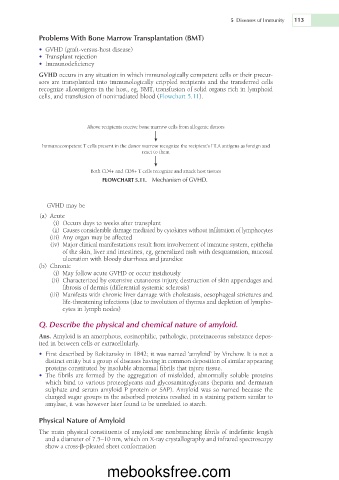
             cells, and transfusion of nonirradiated blood (Flowchart 5.11).


                            Above recipients receive bone marrow cells from allogenic donors


              Immunocompetent T cells present in the donor marrow recognize the recipient’s HLA antigens as foreign and
                                             react to them

                             Both CD4+ and CD8+ T cells recognize and attack host tissues
                                 FLOWCHART 5.11.    Mechanism of GVHD.


               GVHD may be
                 Acute
             (a)
                  (i)  Occurs days to weeks after transplant


                 (ii)  Causes considerable damage mediated by cytokines without infiltration of lymphocytes


                  (iii)  Any organ may be affected


                 (iv)  Major clinical manifestations result from involvement of immune system, epithelia


                    of   the skin, liver and intestines, eg, generalized rash with desquamation, mucosal


                    ulceration   with bloody diarrhoea and jaundice
             (b)
                 Chronic
                  (i)  May follow acute GVHD or occur insidiously

                 (ii)  Characterized by extensive cutaneous injury, destruction of skin appendages and

                    fibrosis of dermis (differential systemic sclerosis)

                  (iii)  Manifests with chronic liver damage with cholestasis, oesophageal strictures and
                    life-threatening infections (due to involution of thymus and depletion of lympho-
                    cytes in lymph nodes)
             Q.   Describe the physical and chemical nature of amyloid.
             Ans.   Amyloid is an amorphous, eosinophilic, pathologic, proteinaceous substance depos-
             ited in between cells or extracellularly.
                •	�First described by Rokitansky in 1842; it was named ‘amyloid’ by Virchow. It is not a
               distinct entity but a group of diseases having in common deposition of similar appearing
               proteins constituted by insoluble abnormal fibrils that injure tissue.
                •	�The  fibrils  are  formed  by  the  aggregation  of  misfolded,  abnormally  soluble  proteins
               which bind to various proteoglycans and glycosaminoglycans (heparin and dermatan
               sulphate and serum amyloid P protein or SAP). Amyloid was so named because the
               charged sugar groups in the adsorbed proteins resulted in a staining pattern similar to
               amylase, it was however later found to be unrelated to starch.
             Physical Nature of Amyloid
             The main physical constituents of amyloid are nonbranching fibrils of indefinite length
               and a diameter of 7.5–10 nm, which on X-ray   crystallography and infrared spectroscopy


               show     a cross-b-pleated sheet conformation

                                  mebooksfree.com

