


Page 127 - Concise Pathology for Exam Preparation ( PDFDrive )
P. 127
112   SECTION I    General Pathology


                     Morphology of rejection
                         Hyperacute rejection
                      (a)
                             Occurs minutes or hours after transplantation and leads to a cyanotic, mottled
                         (i)
                            and flaccid kidney excreting a few drops of bloody urine.
                         (ii)
                             There  is  a  rapid  accumulation  of  neutrophils  within  arterioles,  glomeruli  and
                            peritubular capillaries along with deposits of immunoglobulins and complement
                            in the vessel wall. EM shows endothelial injury with fibrin-plated thrombi.
                     (b)
                         Acute rejection
                         (i)
                             Occurs days, months or even years after transplant.
                         (ii)
                             Both cellular and humoral responses involved.
                         Features of acute cellular rejection:
                           - Increased serum creatinine
                           - Clinical signs of renal failure
                           - Extensive interstitial mononuclear infiltrate, oedema and haemorrhage
                           - Mononuclear cells in the glomerular and peritubular capillaries, which may invade
                           tubules to induce tubular necrosis
                           - Vascular endothelial injury mediated by CD81 T cells

                         Features of acute humoral rejection:
                           - Mediated primarily by the antidonor antibodies


                           - Characterized by the necrotizing vasculitis, endothelial cell necrosis, neutrophilic


                           infiltrate   and deposition of immunoglobulins along with complement and fibrin
                      (c)
                         Chronic rejection
                         (i)
                             Progressive rise of serum creatinine over a period of 4–5 months is the hallmark.
                             It is dominated by vascular changes (dense intimal fibrosis), interstitial fibrosis,
                         (ii)
                            glomerular loss, tubular atrophy, shrinkage of renal parenchyma, interstitial infil-
                            trate of plasma cells and eosinophils.
                     Q.   Differentiate between acute and chronic transplant rejection.
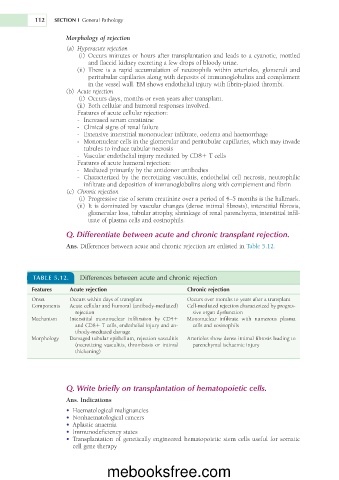
                     Ans.   Differences between acute and chronic rejection are enlisted in Table 5.12.
           TABLE   5.12.   Differences between acute and chronic rejection
           Features   Acute rejection	�                    Chronic rejection
           Onset      Occurs within days of transplant     Occurs over months to years after a transplant
           Components   Acute cellular and humoral (antibody-mediated)   Cell-mediated rejection characterized by progres-
                        rejection                           sive organ dysfunction
           Mechanism   Interstitial  mononuclear  infiltration  by  CD41     Mononuclear  infiltrate  with  numerous  plasma
                        and CD81  T cells, endothelial injury and an-  cells and eosinophils

                        tibody-mediated damage
           Morphology   Damaged tubular epithelium, rejection vasculitis   Arterioles show dense intimal fibrosis leading to
                        (necrotizing  vasculitis,  thrombosis  or  intimal   parenchymal ischaemic injury
                        thickening)
                     Q.   Write briefly on transplantation of hematopoietic cells.
                     Ans.   Indications
                        •	�Haematological malignancies
                        •	�Nonhaematological cancers
                        •	�Aplastic anaemia
                        •	�Immunodeficiency states
                        •	�Transplantation of genetically engineered hematopoietic stem cells useful for somatic
                       cell gene therapy


                                  mebooksfree.com

