


Page 126 - Concise Pathology for Exam Preparation ( PDFDrive )
P. 126
5 Diseases of Immunity 111
• Changes in interstitium and tubules may be seen in cases with diffuse involvement
• Prominent changes in other organs include:
(a) Libman–Sacks endocarditis (nonbacterial verrucous endocarditis)
(b) Capsular thickening, follicular hyperplasia, increased plasma cells and thickening
of penicilliary arteries (onion skinning) in spleen
(c) Pleuritis, pleural effusion, alveolar injury in the form of oedema and haemorrhage
and chronic interstitial fibrosis in lungs
Q. Define transplant rejection. Describe the pathogenesis, clinical
features and morphology of acute and chronic rejection.
Ans. Transplant rejection is defined as recognition by the host of the grafted tissue as
foreign. Rejection is a complex process in which both CMI and circulating antibodies play
a role.
T cell-mediated reactions (cellular rejection):
Occurs due to cytotoxic CD81 T lymphocytes-mediated killing of grafted cells or
delayed hypersensitivity, triggered by activated CD41 T helper cells, and is mediated by
two main pathways:
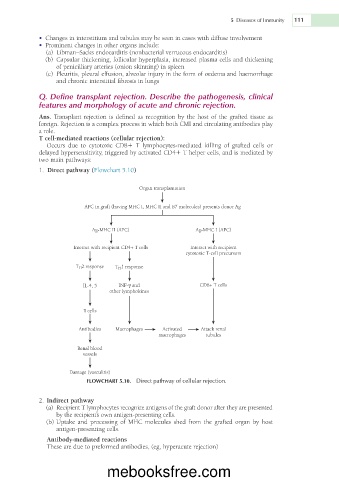
Direct pathway (Flowchart 5.10)
1.
Organ transplantation
APC in graft (having MHC I, MHC II and B7 molecules) presents donor Ag
AgMHC II (APC) AgMHC I (APC)
Interact with recipient CD4+ T cells Interact with recipient
cytotoxic Tcell precursors
T H 2 response T H 1 response
IL4, 5 INFγ and CD8+ T cells
other lymphokines
B cells
Antibodies Macrophages Activated Attack renal
macrophages tubules
Renal blood
vessels
Damage (vasculitis)
FLOWCHART 5.10. Direct pathway of cellular rejection.
Indirect pathway
2.
(a) Recipient T lymphocytes recognize antigens of the graft donor after they are presented
by the recipient’s own antigen-presenting cells.
(b) Uptake and processing of MHC molecules shed from the grafted organ by host
antigen-presenting cells.
Antibody-mediated reactions
These are due to preformed antibodies, (eg, hyperacute rejection)
mebooksfree.com

