


Page 134 - Concise Pathology for Exam Preparation ( PDFDrive )
P. 134
5 Diseases of Immunity 119
env gp120
env gp41
gag p17
gag p24
RNA
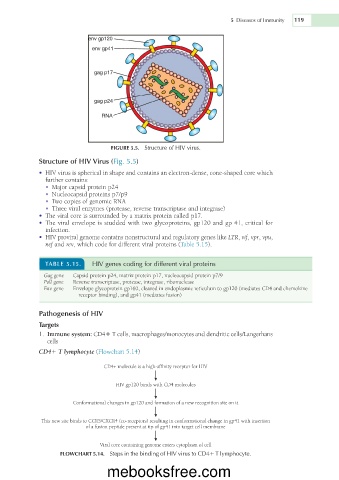
FIGURE 5.5. Structure of HIV virus.
Structure of HIV Virus (Fig. 5.5)
• �HIV virus is spherical in shape and contains an electron-dense, cone-shaped core which
further contains:
• �Major capsid protein p24
• �Nucleocapsid proteins p7/p9
• �Two copies of genomic RNA
• �Three viral enzymes (protease, reverse transcriptase and integrase)
• �The viral core is surrounded by a matrix protein called p17.
i
s
• �The viral envelope studded with two glycoproteins, gp120 and gp 41, critical for
infection.
• �HIV proviral genome contains nonstructural and regulatory genes like LTR, vif, vpr, vpu,
nef and rev, which code for different viral proteins (Table 5.15).
TABLE 5.15. HIV genes coding for different viral proteins
Gag gene Capsid protein p24, matrix protein p17, nucleocapsid protein p7/9
Poll gene Reverse transcriptase, protease, integrase, ribonuclease
Env gene Envelope glycoprotein gp160, cleaved in endoplasmic reticulum to gp120 (mediates CD4 and chemokine
receptor binding), and gp41 (mediates fusion)
Pathogenesis of HIV
Targets
1 .
�Immune system: CD41 T cells, macrophages/monocytes and dendritic cells/Langerhans
cells
CD41 T lymphocyte (Flowchart 5.14)
CD4+ molecule is a highaffinity receptor for HIV
HIV gp120 binds with CD4 molecules
Conformational changes in gp120 and formation of a new recognition site on it
This new site binds to CCR5/CXCR4 (coreceptors) resulting in conformational change in gp41 with insertion
of a fusion peptide present at tip of gp41 into target cell membrane
Viral core containing genome enters cytoplasm of cell
FLOWCHART 5.14. Steps in the binding of HIV virus to CD41 T lymphocyte.
mebooksfree.com

