


Page 139 - Concise Pathology for Exam Preparation ( PDFDrive )
P. 139
124   SECTION I  General Pathology

                     Characteristics:
                     •  Derived from totipotent cells (cells with an ability to differentiate into any cell type),
                       teratomas are usually encountered in gonads. They sometimes develop in sequestered
                       primitive cell rests elsewhere.
                     •  Sacrococcygeal  teratomas  are  the  most  common  tumours  in  newborns,  and  mature
                       cystic teratomas account for 10–20% of all ovarian neoplasms.
                     •  Teratomas  are  also  frequently  seen  in  the  head  and  neck  region,  mediastinum  and
                       retroperitoneum.

                     Q. Define a choristoma.

                     Ans.  A choristoma is an ectopic rest of normal tissue, eg, a rest of adrenal cells under the
                     kidney capsule and pancreatic rest in the intestine.

                     Q. Define a hamartoma.
                     Ans.  Aberrant differentiation may produce a mass of disorganized but mature, specialized
                     cells/tissue indigenous to the particular site (thought to be either an anomalous develop-
                     ment or a neoplasm in origin), eg, hamartoma of the lung.
                     Q. Differentiate between a hamartoma and a neoplasm.

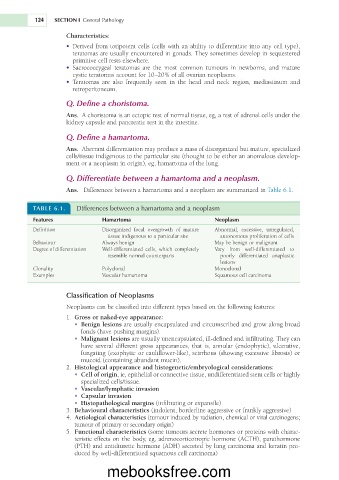
                     Ans.   Differences between a hamartoma and a neoplasm are summarized in Table 6.1.

           TABLE 6.1.    Differences between a hamartoma and a neoplasm

           Features             Hamartoma                          Neoplasm
           Definition           Disorganized  focal  overgrowth  of  mature   Abnormal,  excessive,  unregulated,
                                  tissue indigenous to a particular site  autonomous proliferation of cells
           Behaviour            Always benign                      May be benign or malignant
           Degree of differentiation  Well-differentiated  cells,  which  completely   Vary  from  well-differentiated  to
                                  resemble normal counterparts       poorly  differentiated  anaplastic
                                                                     lesions
           Clonality            Polyclonal                         Monoclonal
           Examples             Vascular hamartoma                 Squamous cell carcinoma


                     Classification of Neoplasms
                     Neoplasms can be classified into different types based on the following features:
                       1.  Gross or naked-eye appearance:
                        •  Benign lesions are usually encapsulated and circumscribed and grow along broad
                          fonds (have pushing margins).
                        •  Malignant lesions are usually unencapsulated, ill-defined and infiltrating. They can
                          have several different gross appearances, that is, annular (endophytic), ulcerative,
                          fungating (exophytic or cauliflower-like), scirrhous (showing excessive fibrosis) or
                          mucoid (containing abundant mucin).
                       2.  Histological appearance and histogenetic/embryological considerations:
                        •  Cell of origin, ie, epithelial or connective tissue, undifferentiated stem cells or highly
                          specialized cells/tissue.
                        •  Vascular/lymphatic invasion
                        •  Capsular invasion
                        •  Histopathological margins (infiltrating or expansile)
                       3.  Behavioural characteristics (indolent, borderline aggressive or frankly aggressive)
                      4.  Aetiological characteristics (tumour induced by radiation, chemical or viral carcinogens;
                        tumour of primary or secondary origin)
                       5.  Functional characteristics (some tumours secrete hormones or proteins with charac-
                        teristic effects on the body, eg, adrenocorticotropic hormone (ACTH), parathormone
                        (PTH) and antidiuretic hormone (ADH) secreted by lung carcinoma and keratin pro-
                        duced by well-differentiated squamous cell carcinoma)


                                  mebooksfree.com

