


Page 206 - Concise Pathology for Exam Preparation ( PDFDrive )
P. 206
8  Genetic and Paediatric Disorders  191

             Q. Define genetic heterogeneity.

             Ans.  The  phenomenon  in  which  mutations  at  different  genetic  loci  produce  the  same
             result  is  called  genetic  heterogeneity,  eg,  retinitis  pigmentosa,  a  disorder  of  abnormal
             retinal pigmentation and visual impairment can be caused by several different types of
             mutations.

             Q. Define aneuploidy.
             Ans.  Humans have 46 chromosomes consisting of 22 pairs of autosomes or somatic
             chromosomes and 2 sex chromosomes (XX 5 female and XY 5 male). The gametes
             contain a haploid number of chromosomes (n 5 23). The union of two sex cells (egg
             and  sperm),  each  with  only  haploid  number  of  chromosomes,  results  in  a  diploid
             zygote (2n).
               ‘Hyperdiploidy’ is a chromosomal number more than diploid and ‘hypodiploidy’
             is a chromosomal number less than diploid. Aneuploidy refers to the presence of an
             uneven  multiple  of  23  chromosomes.  It  is  most  frequently  due  to  nondisjunction,  in
             which one set of homologous chromosomes fails to separate during the first meiotic divi-
             sion (one gamete has 22 chromosomes and the other 24 chromosomes).

             Q. What is chromosomal translocation?
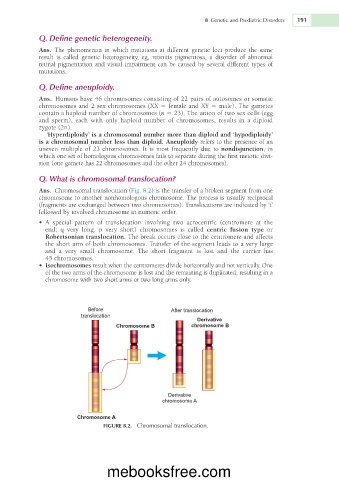
             Ans.  Chromosomal translocation (Fig. 8.2) is the transfer of a broken segment from one
             chromosome to another nonhomologous chromosome. The process is usually reciprocal
             (fragments are exchanged between two chromosomes). Translocations are indicated by ‘t’
             followed by involved chromosome in numeric order.
             •  A  special  pattern  of  translocation  involving  two  acrocentric  (centromere  at  the
               end;  q  very  long,  p  very  short)  chromosomes  is  called  centric  fusion  type  or
               Robertsonian translocation. The break occurs close to the centromere and affects
               the short arm of both chromosomes. Transfer of the segment leads to a very large
               and  a  very  small  chromosome.  The  short  fragment  is  lost  and  the  carrier  has
               45 chromosomes.
             •  Isochromosomes result when the centromeres divide horizontally and not vertically. One
               of the two arms of the chromosome is lost and the remaining is duplicated, resulting in a
               chromosome with two short arms or two long arms only.


                            Before                    After translocation
                          translocation
                                                              Derivative
                                     Chromosome B           chromosome B


                                                     Derivative
                                                   chromosome A

                         Chromosome A
                                 FIGURE 8.2.  Chromosomal translocation.


                                  mebooksfree.com

