


Page 201 - Concise Pathology for Exam Preparation ( PDFDrive )
P. 201
186   SECTION I  General Pathology


                                                                      Mucosa


                                   Muscularis mucosae  Flask shaped ulcer  Lamina propria
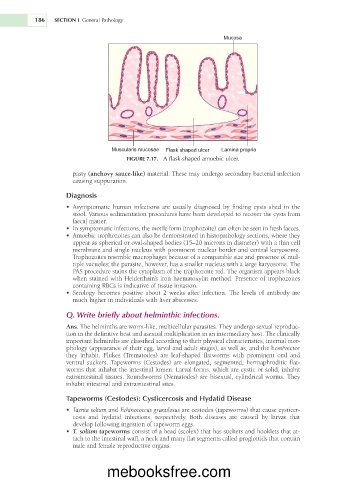
                                        FIGURE 7.17.  A flask-shaped amoebic ulcer.

                       pasty (anchovy sauce-like) material. These may undergo secondary bacterial infection
                       causing suppuration.

                     Diagnosis
                     •  Asymptomatic  human  infections  are  usually  diagnosed  by  finding  cysts  shed  in  the
                       stool. Various sedimentation procedures have been developed to recover the cysts from
                       faecal matter.
                     •  In symptomatic infections, the motile form (trophozoite) can often be seen in fresh faeces.
                     •  Amoebic trophozoites can also be demonstrated in histopathology sections, where they
                       appear as spherical or oval-shaped bodies (15–20 microns in diameter) with a thin cell
                       membrane and single nucleus with prominent nuclear border and central karyosome.
                       Trophozoites resemble macrophages because of a comparable size and presence of mul-
                       tiple vacuoles; the parasite, however, has a smaller nucleus with a large karyosome. The
                       PAS procedure stains the cytoplasm of the trophozoite red. The organism appears black
                       when stained with Heidenhain’s iron haematoxylin method. Presence of trophozoites
                       containing RBCs is indicative of tissue invasion.
                     •  Serology  becomes  positive  about  2  weeks  after  infection.  The  levels  of  antibody  are
                       much higher in individuals with liver abscesses.

                     Q. Write briefly about helminthic infections.
                     Ans. The helminths are worm-like, multicellular parasites. They undergo sexual reproduc-
                     tion in the definitive host and asexual multiplication in an intermediary host. The clinically
                     important helminths are classified according to their physical characteristics, internal mor-
                     phology (appearance of their egg, larval and adult stages), as well as, and the host/vector
                     they  inhabit.  Flukes  (Trematodes)  are  leaf-shaped  flatworms  with  prominent  oral  and
                     ventral  suckers.  Tapeworms  (Cestodes)  are  elongated,  segmented,  hermaphroditic  flat-
                     worms that inhabit the intestinal lumen. Larval forms, which are cystic or solid, inhabit
                     extraintestinal tissues. Roundworms (Nematodes) are bisexual, cylindrical worms. They
                     inhabit intestinal and extraintestinal sites.

                     Tapeworms (Cestodes): Cysticercosis and Hydatid Disease
                     •  Taenia solium and Echinococcus granulosus are cestodes (tapeworms) that cause cysticer-
                       cosis  and  hydatid  infections,  respectively.  Both  diseases  are  caused  by  larvae  that
                       develop following ingestion of tapeworm eggs.
                     •  T. solium tapeworms consist of a head (scolex) that has suckers and hooklets that at-
                       tach to the intestinal wall, a neck and many flat segments called proglottids that contain
                       male and female reproductive organs.


                                  mebooksfree.com

