


Page 204 - Concise Pathology for Exam Preparation ( PDFDrive )
P. 204
8


                                  Genetic and Paediatric


                                                                Disorders


             PART I: GENETIC DISORDERS
             Q. Write briefly on the structure of a gene.
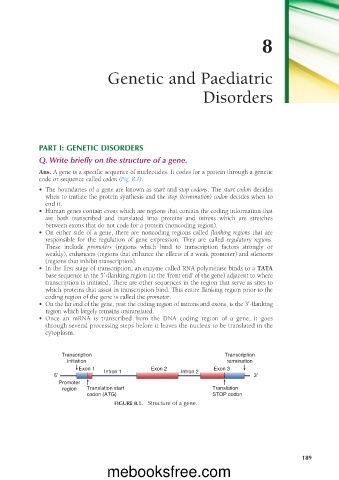
             Ans. A gene is a specific sequence of nucleotides. It codes for a protein through a genetic
             code or sequence called codon (Fig. 8.1).
             •  The boundaries of a gene are known as start and stop codons. The start codon decides
               when to initiate the protein synthesis and the stop (termination) codon decides when to
               end it.
             •  Human genes contain exons which are regions that contain the coding information that
               are  both  transcribed  and  translated  into  proteins  and  introns  which  are  stretches
               between exons that do not code for a protein (noncoding region).
             •  On either side of a gene, there are noncoding regions called flanking regions that are
               responsible  for  the  regulation  of  gene  expression.  They  are  called  regulatory  regions.
               These  include  promoters  (regions  which  bind  to  transcription  factors  strongly  or
               weakly), enhancers (regions that enhance the effects of a weak promoter) and silencers
               (regions that inhibit transcription).
             •  In the first stage of transcription, an enzyme called RNA polymerase binds to a TATA
               base sequence in the 5’-flanking region (at the ‘front end’ of the gene) adjacent to where
               transcription is initiated. There are other sequences in the region that serve as sites to
               which proteins that assist in transcription bind. This entire flanking region prior to the
               coding region of the gene is called the promotor.
             •  On the far end of the gene, past the coding region of introns and exons, is the 3’-flanking
               region which largely remains untranslated.
             •  Once  an  mRNA  is  transcribed  from  the  DNA  coding  region  of  a  gene,  it  goes
               through several processing steps before it leaves the nucleus to be translated in the
               cytoplasm.


                    Transcription                                     Transcription
                      initiation                                       termination
                         Exon 1  Intron 1      Exon 2    Intron 2  Exon 3
                  5’                                                           3’
                   Promoter
                    region  Translation start                     Translation
                            codon (ATG)                           STOP codon
                                    FIGURE 8.1.  Structure of a gene.


                                                                                              189

                                  mebooksfree.com

