


Page 202 - Concise Pathology for Exam Preparation ( PDFDrive )
P. 202
7  Infections  187


             •  When pigs ingest the proglottids or eggs, the eggs hatch, penetrate their intestinal wall,
               and spread to skeletal muscle, especially the neck, tongue and trunk. There, the larvae
               mature into encysted cysticerci over 2–3 months.
             •  The  cysticerci  suppress  the  host  inflammatory  response  and  survive  in  tissues  for
               months to years. The life cycle is completed when humans ingest inadequately cooked
               pork that contains viable cysticerci or eggs.
             •  The larvae hatch, penetrate the gut wall, disseminate haematogenously, and encyst in
               many organs. The egg-containing faeces usually contaminate water supplies in endemic
               areas. If this water is used to irrigate fruits and vegetables, eggs are ingested with the
               contaminated food. Thus, people who have never visited endemic countries can also
               develop infection.
             •  Autoinfection  involves  the  retrograde  transmission  of  proglottids  from  the  intestines
               into the stomach with subsequent release of T. solium eggs into the gut.
             •  The clinical syndromes caused by T. solium are categorized as neurocysticercosis or
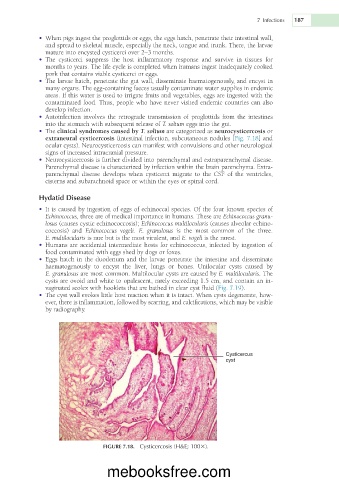
               extraneural cysticercosis (intestinal infection, subcutaneous nodules [Fig. 7.18] and
               ocular cysts). Neurocysticercosis can manifest with convulsions and other neurological
               signs of increased intracranial pressure.
             •  Neurocysticercosis is further divided into parenchymal and extraparenchymal disease.
               Parenchymal disease is characterized by infection within the brain parenchyma. Extra-
               parenchymal  disease  develops  when  cysticerci  migrate  to  the  CSF  of  the  ventricles,
               cisterns and subarachnoid space or within the eyes or spinal cord.

             Hydatid Disease

             •  It is caused by ingestion of eggs of echinoccal species. Of the four known species of
               Echinococcus, three are of medical importance in humans. These are Echinococcus granu-
               losus (causes cystic echinococcosis); Echinococcus multilocularis (causes alveolar echino-
               coccosis)  and  Echinococcus  vogeli.  E.  granulosus  is  the  most  common  of  the  three.
               E. multilocularis is rare but is the most virulent, and E. vogeli is the rarest.
             •  Humans are accidental intermediate hosts for echinococcus, infected by ingestion of
               food contaminated with eggs shed by dogs or foxes.
             •  Eggs hatch in the duodenum and the larvae penetrate the intestine and disseminate
               haematogenously  to  encyst  the  liver,  lungs  or  bones.  Unilocular  cysts  caused  by
               E. granulosus are most common. Multilocular cysts are caused by E. multilocularis. The
               cysts are ovoid and white to opalescent, rarely exceeding 1.5 cm, and contain an in-
               vaginated scolex with hooklets that are bathed in clear cyst fluid (Fig. 7.19).
             •  The cyst wall evokes little host reaction when it is intact. When cysts degenerate, how-
               ever, there is inflammation, followed by scarring, and calcifications, which may be visible
               by radiography.


                                                                       Cysticercus
                                                                       cyst


                                 FIGURE 7.18.  Cysticercosis (H&E; 1003).


                                  mebooksfree.com

