


Page 221 - Concise Pathology for Exam Preparation ( PDFDrive )
P. 221
206    SECTION I  General Pathology


                            (ii)  Permanent neurological sequelae common.
                             (iii)  Positive serologic test (TORCH) indicates disease.
                         (e)  Syphilis
                             (i)  Primarily transplacental transmission.
                            (ii)  Symptoms  and  signs  appear  in  first  1–2  months  after  birth  and  include
                               mucocutaneous  lesions,  lobar  pneumonia,  persistent  rhinitis  (snuffles),
                               osteochondritis and hepatomegaly.
                             (iii)  Prominent  late  manifestations  are  bone  abnormalities  (saber  shins)  and
                               Hutchinson’s  triad  (malformed,  notched  upper  central  incisors,  interstitial
                               keratitis leading to blindness and nerve deafness).
                            (iv)  Rising VDRL titer; positive FTA-ABS-IgM are diagnostic.

                     Q. Write briefly on the disorders associated with prematurity.
                     Ans.  Newborns may be classified as appropriate for gestational age (AGA), small for gestational
                     age (SGA) or large for gestational age (LGA).
                     •  Term newborns are those born between 37 and 42 weeks, pre-term newborns are those born
                       before 37 weeks and post-term newborns are those born after 42 weeks.
                     •  Infants born before completion of gestation usually weigh less than normal (2500 g).
                     •  Prematurity is second only to congenital malformations as a cause of infant mortality.
                     •  Preterm infants have immature organs, which predisposes them to various compli-
                       cations, eg, immature lungs (that lack surfactant and are prone to develop respira-
                       tory distress syndrome), necrotizing enterocolitis and intraventricular haemorrhage.

                     PART II: DISEASES OF INFANCY AND CHILDHOOD
                     Q. Write briefly on neonatal respiratory distress syndrome/hyaline
                     membrane disease.
                     Ans.  Characterized by formation of pulmonary hyaline membrane, neonatal respiratory
                     distress syndrome is associated with the following conditions:
                     •  Preterm infants.
                     •  Infants born to diabetic mothers.
                     •  Caesarean section delivery.
                     •  Excessive sedation of mother during labour.
                     •  Other birth-related asphyxias.

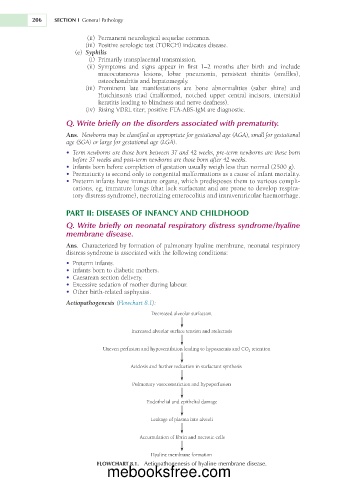
                     Aetiopathogenesis (Flowchart 8.1):
                                                Decreased alveolar surfactant

                                          Increased alveolar surface tension and atelectasis

                                 Uneven perfusion and hypoventilation leading to hypoxaemia and CO  retention
                                                                              2

                                         Acidosis and further reduction in surfactant synthesis

                                          Pulmonary vasoconstriction and hypoperfusion


                                              Endothelial and epithelial damage

                                               Leakage of plasma into alveoli


                                            Accumulation of fibrin and necrotic cells

                                                Hyaline membrane formation
                               FLOWCHART 8.1.  Aetiopathogenesis of hyaline membrane disease.
                                  mebooksfree.com

