


Page 224 - Concise Pathology for Exam Preparation ( PDFDrive )
P. 224
8  Genetic and Paediatric Disorders  209

             Q. Describe the clinicopathological features of neuroblastoma.

             Ans.  Enlisted below are the important clinicopathological features of neuroblastoma:

             Clinical Presentation
             •  Second  most  common  solid  malignancy  of  childhood  after  brain  tumours;  most
               common in infants (,1 year of age).
             •  Mostly sporadic, rarely familial with AD transmission.
             •  Most  common  site  is  adrenal  medulla;  other  sites—anywhere  along  sympathetic  chain
               (paravertebral region of the posterior mediastinum and lower abdomen).
             •  Familial  cases  are  associated  with  germline  mutations  in  the  anaplastic  lymphoma
               kinase (ALK) gene. Somatic gain of function mutations also seen in less than 10% cases
               (inhibitors of this kinase are being used as potential treatment for neuroblastoma).
             Gross Morphology

             •  Neuroblastomas vary from being in situ lesions (small nodule) to large masses.
             •  In situ lesions may regress to leave only small foci of fibrosis and calcification (spontane-
               ous regression or therapy-induced maturation).
             •  Some tumours appear encapsulated and sharply demarcated, while others are highly infiltrative.
             •  Cut surface is soft, grey, brain-like with areas of necrosis and haemorrhage.

             Microscopic Features
             •  Tumour is constituted by small, primitive-looking cells having dark nuclei, scant cyto-
               plasm and poorly defined cell margins arranged in sheets.
             •  Mitotic activity, nuclear breakdown (karyorrhexis) and pleomorphism is prominent.
             •  Eosinophilic  fibrillary  background  (neurophil  or  neuritic  processes  of  primitive
               neuroblasts) is indicative of a neural origin.
             •  Homer Wright pseudorosettes (tumour cells arranged around a central space filled with
               their fibrillar extensions) may be seen.
             Clinical Features

             •  Usually present with a large abdominal mass, fever and weight loss.
             •  Metastases may cause hepatomegaly, ascites and bone pain.
             •  In  neonates,  disseminated  neuroblastomas  may  present  with  multiple  cutaneous
               metastases and deep blue discolouration of the skin (blueberry muffin baby).
             •  About 90% tumours produce catecholamines and are associated with elevated levels
               of catecholamine metabolites like vanillylmandelic acid (VMA) and homovanillic acid
               (HVA) in the urine.
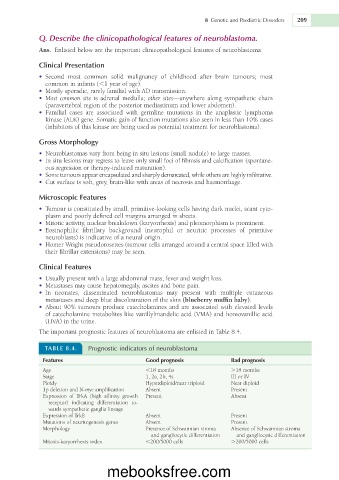
             The important prognostic features of neuroblastoma are enlisted in Table 8.4.

               TABLE 8.4.   Prognostic indicators of neuroblastoma

              Features                        Good prognosis            Bad prognosis
              Age                             ,18 months                .18 months
              Stage                           1, 2a, 2b, 4s             III or IV
              Ploidy                          Hyperdiploid/near triploid  Near diploid
              1p deletion and N-myc amplification  Absent               Present
              Expression  of  TrkA  (high  affinity  growth   Present   Absent
                receptor)  indicating  differentiation  to-
                wards sympathetic ganglia lineage
              Expression of TrkB              Absent                    Present
              Mutations of neuritogenesis genes  Absent                 Present
              Morphology                      Presence of Schwannian stroma   Absence of Schwannian stroma
                                                and gangliocytic differentiation  and gangliocytic differentiation
              Mitosis-karyorrhexis index      ,200/5000 cells           .200/5000 cells


                                  mebooksfree.com

