


Page 223 - Concise Pathology for Exam Preparation ( PDFDrive )
P. 223
208    SECTION I  General Pathology


                     2.  Nonimmune hydrops
                        •  Major  causes  include  cardiovascular  defects,  chromosomal  anomalies  (Turner
                          syndrome,  trisomies  18  and  21)  and  fetal  anaemia  (eg,  that  associated  with
                          homozygous a-thalassaemia) resulting in intrauterine cardiac failure.
                        •  Transplacental infection with parvovirus B19 is emerging as an important cause of
                          fetal hydrops.
                     Morphology of Hydrops

                     -  Presence of dysmorphic features suggests underlying chromosomal abnormalities.
                     -  Postmortem examination may reveal a cardiac anomaly.
                     -  In hydrops associated with fetal anaemia, both the fetus and the placenta are character-
                       istically pale.
                     -  In most cases, there is hepatosplenomegaly.
                     -  Compensatory erythroid hyperplasia may be seen in the marrow and extramedullary hae-
                       matopoiesis may be seen in liver, spleen, kidneys and lungs.
                     -  Haemolysis leads to increased unconjugated bilirubin.
                     -  CNS is damaged when bilirubin levels are more than 20 mg/dL. Basal ganglia and brain
                       stem are prone to deposition of bilirubin (Kernicterus).

                     Q. Enumerate the common malignant tumours of infancy
                     and childhood.
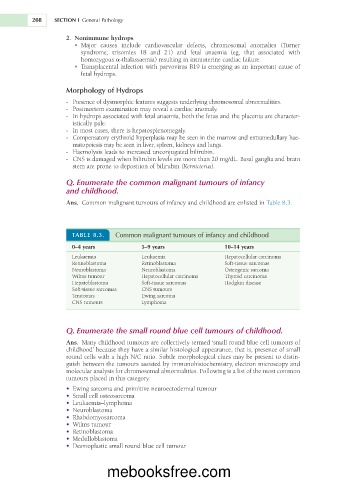
                     Ans.  Common malignant tumours of infancy and childhood are enlisted in Table 8.3.


                       TABLE 8.3.    Common malignant tumours of infancy and childhood

                       0–4 years             5–9 years                10–14 years
                       Leukaemia             Leukaemia                Hepatocellular carcinoma
                       Retinoblastoma        Retinoblastoma           Soft-tissue sarcomas
                       Neuroblastoma         Neuroblastoma            Osteogenic sarcoma
                       Wilms tumour          Hepatocellular carcinoma  Thyroid carcinoma
                       Hepatoblastoma        Soft-tissue sarcomas     Hodgkin disease
                       Soft-tissue sarcomas  CNS tumours
                       Teratomas             Ewing sarcoma
                       CNS tumours           Lymphoma


                     Q. Enumerate the small round blue cell tumours of childhood.
                     Ans.  Many childhood tumours are collectively termed ‘small round blue cell tumours of
                     childhood’ because they have a similar histological appearance, that is, presence of small
                     round cells with a high N/C ratio. Subtle morphological clues may be present to distin-
                     guish between the tumours assisted by immunohistochemistry, electron microscopy and
                     molecular analysis for chromosomal abnormalities. Following is a list of the most common
                     tumours placed in this category:
                     •  Ewing sarcoma and primitive neuroectodermal tumour
                     •  Small cell osteosarcoma
                     •  Leukaemia–lymphoma
                     •  Neuroblastoma
                     •  Rhabdomyosarcoma
                     •  Wilms tumour
                     •  Retinoblastoma
                     •  Medulloblastoma
                     •  Desmoplastic small round blue cell tumour


                                  mebooksfree.com

