


Page 252 - Concise Pathology for Exam Preparation ( PDFDrive )
P. 252
10  Blood Vessels  237

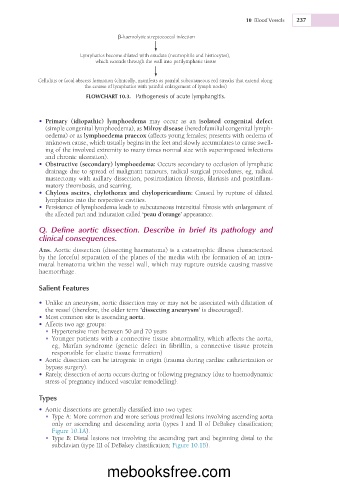
                                     β-haemolytic streptococcal infection


                          Lymphatics become dilated with exudate (neutrophils and histiocytes),
                              which extends through the wall into perilymphatic tissue


             Cellulitis or focal abscess formation (clinically, manifests as painful subcutaneous red streaks that extend along
                           the course of lymphatics with painful enlargement of lymph nodes)
                            FLOWCHART 10.3.  Pathogenesis of acute lymphangitis.


             •  Primary  (idiopathic)  lymphoedema  may  occur  as  an  isolated  congenital  defect
               (simple congenital lymphoedema), as Milroy disease (heredofamilial congenital lymph-
               oedema) or as lymphoedema praecox (affects young females; presents with oedema of
               unknown cause, which usually begins in the feet and slowly accumulates to cause swell-
               ing of the involved extremity to many times normal size with superimposed infections
               and chronic ulceration).
             •  Obstructive (secondary) lymphoedema: Occurs secondary to occlusion of lymphatic
               drainage due to spread of malignant tumours, radical surgical procedures, eg, radical
               mastectomy with axillary dissection, postirradiation fibrosis, filariasis and postinflam-
               matory thrombosis, and scarring.
             •  Chylous ascites, chylothorax and chylopericardium: Caused by rupture of dilated
               lymphatics into the respective cavities.
             •  Persistence of lymphoedema leads to subcutaneous interstitial fibrosis with enlargement of
               the affected part and induration called ‘peau d’orange’ appearance.

             Q.  Define  aortic  dissection.  Describe  in  brief  its  pathology  and
             clinical consequences.
             Ans. Aortic dissection (dissecting haematoma) is a catastrophic illness characterized
             by the forceful separation of the planes of the media with the formation of an intra-
             mural hematoma within the vessel wall, which may rupture outside causing massive
             haemorrhage.
             Salient Features


             •  Unlike an aneurysm, aortic dissection may or may not be associated with dilatation of
               the vessel (therefore, the older term ‘dissecting aneurysm’ is discouraged).
             •  Most common site is ascending aorta.
             •  Affects two age groups:
               •  Hypertensive men between 50 and 70 years
               •  Younger patients with a connective tissue abnormality, which affects the aorta,
                 eg,  Marfan  syndrome  (genetic  defect  in  fibrillin,  a  connective  tissue  protein
                 responsible for elastic tissue formation)
             •  Aortic dissection can be iatrogenic in origin (trauma during cardiac catheterization or
               bypass surgery).
             •  Rarely, dissection of aorta occurs during or following pregnancy (due to haemodynamic
               stress of pregnancy induced vascular remodelling).

             Types
             •  Aortic dissections are generally classified into two types:
               •  Type A: More common and more serious proximal lesions involving ascending aorta
                 only  or  ascending  and  descending  aorta  (types  I  and  II  of  DeBakey  classification;
                 Figure 10.1A).
               •  Type B: Distal lesions not involving the ascending part and beginning distal to the
                 subclavian (type III of DeBakey classification; Figure 10.1B).


                                  mebooksfree.com

