


Page 253 - Concise Pathology for Exam Preparation ( PDFDrive )
P. 253
238    SECTION II  Diseases of Organ Systems

                                             Type A                  Type B

                                   DeBakey l         DeBakey ll    DeBakey lll


                            Intimal
                             tear              Intimal           Intimal
                                                tear              tear


                            A                                B
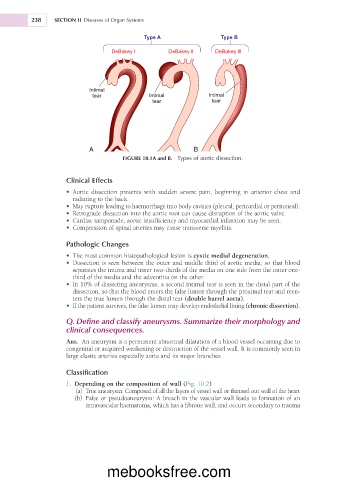
                                       FIGURE 10.1A and B.  Types of aortic dissection.


                     Clinical Effects
                     •  Aortic  dissection  presents  with  sudden  severe  pain,  beginning  in  anterior  chest  and
                       radiating to the back.
                     •  May rupture leading to haemorrhage into body cavities (pleural, pericardial or peritoneal).
                     •  Retrograde dissection into the aortic root can cause disruption of the aortic valve.
                     •  Cardiac tamponade, aortic insufficiency and myocardial infarction may be seen.
                     •  Compression of spinal arteries may cause transverse myelitis.

                     Pathologic Changes
                     •  The most common histopathological lesion is cystic medial degeneration.
                     •  Dissection is seen between the outer and middle third of aortic media; so that blood
                       separates the intima and inner two-thirds of the media on one side from the outer one-
                       third of the media and the adventitia on the other.
                     •  In 10% of dissecting aneurysms, a second intimal tear is seen in the distal part of the
                       dissection, so that the blood enters the false lumen through the proximal tear and reen-
                       ters the true lumen through the distal tear (double barrel aorta).
                     •  If the patient survives, the false lumen may develop endothelial lining (chronic dissection).

                     Q. Define and classify aneurysms. Summarize their morphology and
                     clinical consequences.

                     Ans.  An aneurysm is a permanent abnormal dilatation of a blood vessel occurring due to
                     congenital or acquired weakening or destruction of the vessel wall. It is commonly seen in
                     large elastic arteries especially aorta and its major branches.

                     Classification
                       1.  Depending on the composition of wall (Fig. 10.2)
                         (a)  True aneurysm: Composed of all the layers of vessel wall or thinned out wall of the heart
                         (b)  False or pseudoaneurysm: A breach in the vascular wall leads to formation of an
                           intravascular haematoma, which has a fibrous wall, and occurs secondary to trauma


                                  mebooksfree.com

