


Page 254 - Concise Pathology for Exam Preparation ( PDFDrive )
P. 254
10  Blood Vessels  239


                                       True aneurysm       False aneurysm
             Normal blood  A. Fusiform  B. Saccular  C. Cylindrcal
                vessel    aneurysm  aneurysm     aneurysm


                                                                      Extravasation of blood
                                                                      into extravascular
                                                                      tissue
                                                                      Hematoma formation


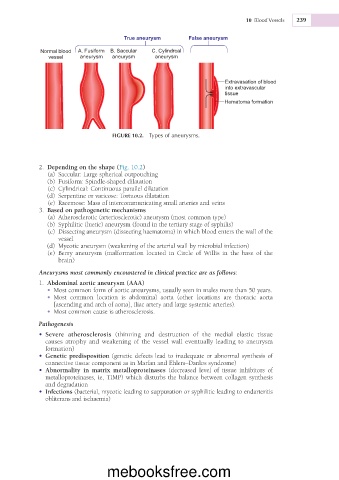
                                    FIGURE 10.2.  Types of aneurysms.


               2.  Depending on the shape (Fig. 10.2)
                 (a)  Saccular: Large spherical outpouching
                 (b)  Fusiform: Spindle-shaped dilatation
                 (c)  Cylindrical: Continuous parallel dilatation
                  (d)  Serpentine or varicose: Tortuous dilatation
                 (e)  Racemose: Mass of intercommunicating small arteries and veins
               3.  Based on pathogenetic mechanisms
                 (a)  Atherosclerotic (arteriosclerotic) aneurysm (most common type)
                 (b)  Syphilitic (luetic) aneurysm (found in the tertiary stage of syphilis)
                 (c)  Dissecting aneurysm (dissecting haematoma) in which blood enters the wall of the
                   vessel
                  (d)  Mycotic aneurysm (weakening of the arterial wall by microbial infection)
                 (e)  Berry  aneurysm  (malformation  located  in  Circle  of  Willis  in  the  base  of  the
                   brain)

             Aneurysms most commonly encountered in clinical practice are as follows:
               1.  Abdominal aortic aneurysm (AAA)
                •  Most common form of aortic aneurysms, usually seen in males more than 50 years.
                •  Most  common  location  is  abdominal  aorta  (other  locations  are  thoracic  aorta
                  [ascending and arch of aorta], iliac artery and large systemic arteries).
                •  Most common cause is atherosclerosis.

             Pathogenesis
             •  Severe  atherosclerosis  (thinning  and  destruction  of  the  medial  elastic  tissue
               causes  atrophy  and  weakening  of  the  vessel  wall  eventually  leading  to  aneurysm
               formation)
             •  Genetic predisposition (genetic defects lead to inadequate or abnormal synthesis of
               connective tissue component as in Marfan and Ehlers–Danlos syndrome)
             •  Abnormality  in  matrix  metalloproteinases  (decreased  level  of  tissue  inhibitors  of
               metalloproteinases, ie, TIMP) which disturbs the balance between collagen synthesis
               and degradation
             •  Infections (bacterial, mycotic leading to suppuration or syphilitic leading to endarteritis
               obliterans and ischaemia)


                                  mebooksfree.com

