


Page 257 - Concise Pathology for Exam Preparation ( PDFDrive )
P. 257
242    SECTION II  Diseases of Organ Systems


                         (g)  Lifestyle: Type A behaviour characterized by the aggressiveness, competitiveness
                           and drive have increased risk.
                          (h)  Hyperhomocystinaemia and homocystinuria: High levels of circulating homo-
                           cysteine may lead to endothelial injury and vascular disease.

                     Q. Write in brief on the pathogenesis of atherosclerosis.
                     Ans.  The exact pathogenesis of atherosclerosis is not known; it is thought to be a multi-
                     factorial disease. Many theories have been put forward:
                     •  Encrustation hypothesis proposed by Rokitansky in year 1852: Atheroma represents
                       lipid  encrustation  on  the  arterial  wall  and  formation  of  thrombus  by  components  of
                       blood (platelets, fibrin and leukocytes).
                     •  Insudation hypothesis proposed by Virchow in year 1856: There is cellular prolif-
                       eration of intimal cells due to increased imbibing of lipids from blood (‘lipid theory’).
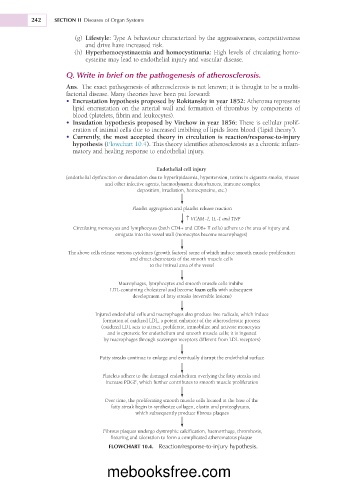
                     •  Currently, the most accepted theory in circulation is reaction/response-to-injury
                       hypothesis (Flowchart 10.4). This theory identifies atherosclerosis as a chronic inflam-
                       matory and healing response to endothelial injury.


                                                 Endothelial cell injury
                     (endothelial dysfunction or denudation due to hyperlipidaemia, hypertension, toxins in cigarette smoke, viruses
                                 and other infective agents, haemodynamic disturbances, immune complex
                                           deposition, irradiation, homocysteine, etc.)


                                          Platelet aggregation and platelet release reaction
                                                          ↑ VCAM -1, IL-1 and TNF
                        Circulating monocytes and lymphocytes (both CD4+ and CD8+ T cells) adhere to the area of injury and
                                     emigrate into the vessel wall (monocytes become macrophages)


                      The above cells release various cytokines (growth factors) some of which induce smooth muscle proliferation
                                         and direct chemotaxis of the smooth muscle cells
                                               to the intimal area of the vessel


                                     Macrophages, lymphocytes and smooth muscle cells imbibe
                                   LDL-containing cholesterol and become foam cells with subsequent
                                          development of fatty streaks (reversible lesions)


                              Injured endothelial cells and macrophages also produce free radicals, which induce
                                 formation of oxidized LDL, a potent enhancer of the atherosclerotic process
                                (oxidized LDL acts to attract, proliferate, immobilize and activate monocytes
                                  and is cytotoxic for endothelium and smooth muscle cells; it is ingested
                                 by macrophages through scavenger receptors different from LDL receptors)

                                Fatty streaks continue to enlarge and eventually disrupt the endothelial surface


                                 Platelets adhere to the damaged endothelium overlying the fatty streaks and
                                  increase PDGF, which further contributes to smooth muscle proliferation

                                 Over time, the proliferating smooth muscle cells located at the base of the
                                   fatty streak begin to synthesize collagen, elastin and proteoglycans,
                                           which subsequently produce fibrous plaques

                                 Fibrous plaques undergo dystrophic calcification, haemorrhage, thrombosis,
                                   fissuring and ulceration to form a complicated atheromatous plaque
                                  FLOWCHART 10.4.  Reaction/response-to-injury hypothesis.


                                  mebooksfree.com

