


Page 264 - Concise Pathology for Exam Preparation ( PDFDrive )
P. 264
10  Blood Vessels  249


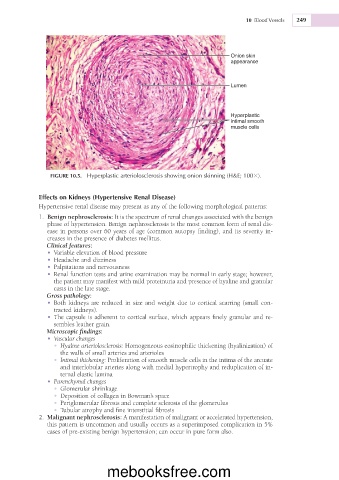
                                                                        Onion skin
                                                                        appearance


                                                                        Lumen


                                                                        Hyperplastic
                                                                        intimal smooth
                                                                        muscle cells


                 FIGURE 10.5.  Hyperplastic arteriolosclerosis showing onion skinning (H&E; 1003).


             Effects on Kidneys (Hypertensive Renal Disease)
             Hypertensive renal disease may present as any of the following morphological patterns:
               1.  Benign nephrosclerosis: It is the spectrum of renal changes associated with the benign
                phase of hypertension. Benign nephrosclerosis is the most common form of renal dis-
                ease in persons over 60 years of age (common autopsy finding), and its severity in-
                creases in the presence of diabetes mellitus.
               Clinical features:
                •  Variable elevation of blood pressure
                •  Headache and dizziness
                •  Palpitations and nervousness
                •  Renal function tests and urine examination may be normal in early stage; however,
                  the patient may manifest with mild proteinuria and presence of hyaline and granular
                  casts in the late stage.
               Gross pathology:
                •  Both kidneys are reduced in size and weight due to cortical scarring (small con-
                  tracted kidneys).
                •  The capsule is adherent to cortical surface, which appears finely granular and re-
                  sembles leather grain.
               Microscopic findings:
                •  Vascular changes
                  •  Hyaline arteriolosclerosis: Homogeneous eosinophilic thickening (hyalinization) of
                    the walls of small arteries and arterioles
                  •  Intimal thickening: Proliferation of smooth muscle cells in the intima of the arcuate
                    and interlobular arteries along with medial hypertrophy and reduplication of in-
                    ternal elastic lamina
                •  Parenchymal changes
                  •  Glomerular shrinkage
                  •  Deposition of collagen in Bowman’s space
                  •  Periglomerular fibrosis and complete sclerosis of the glomerulus
                  •  Tubular atrophy and fine interstitial fibrosis
               2.  Malignant nephrosclerosis: A manifestation of malignant or accelerated hypertension,
                this pattern is uncommon and usually occurs as a superimposed complication in 5%
                cases of pre-existing benign hypertension; can occur in pure form also.


                                  mebooksfree.com

