


Page 260 - Concise Pathology for Exam Preparation ( PDFDrive )
P. 260
10  Blood Vessels  245


             Q. Classify hypertension. Write briefly about the factors regulating
             blood pressure and describe its morphological effects.

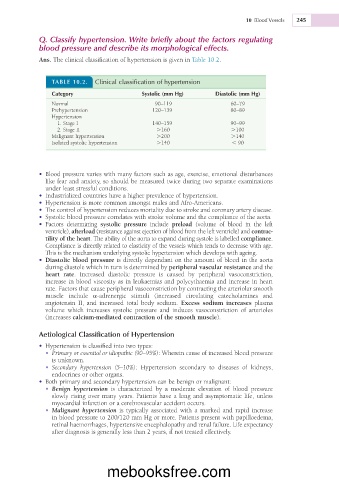
             Ans. The clinical classification of hypertension is given in Table 10.2.


                 TABLE 10.2.  Clinical classification of hypertension
                 Category                    Systolic (mm Hg)      Diastolic (mm Hg)
                 Normal                          90–119                 60–79
                 Prehypertension                120–139                 80–89
                 Hypertension
                   1. Stage I                   140–159                 90–99
                   2. Stage II                   .160                   .100
                 Malignant hypertension          .200                   .140
                 Isolated systolic hypertension  .140                   , 90


             •  Blood pressure varies with many factors such as age, exercise, emotional disturbances
               like fear and anxiety, so should be measured twice during two separate examinations
               under least stressful conditions.
             •  Industrialized countries have a higher prevalence of hypertension.
             •  Hypertension is more common amongst males and Afro-Americans.
             •  The control of hypertension reduces mortality due to stroke and coronary artery disease.
             •  Systolic blood pressure correlates with stroke volume and the compliance of the aorta.
             •  Factors  determining  systolic  pressure  include  preload  (volume  of  blood  in  the  left
               ventricle), afterload (resistance against ejection of blood from the left ventricle) and contrac-
               tility of the heart. The ability of the aorta to expand during systole is labelled compliance.
               Compliance is directly related to elasticity of the vessels which tends to decrease with age.
               This is the mechanism underlying systolic hypertension which develops with ageing.
             •  Diastolic blood pressure is directly dependant on the amount of blood in the aorta
               during diastole which in turn is determined by peripheral vascular resistance and the
               heart  rate.  Increased  diastolic  pressure  is  caused  by  peripheral  vasoconstriction,
               increase in blood viscosity as in leukaemias and polycythaemia and increase in heart
               rate. Factors that cause peripheral vasoconstriction by contracting the arteriolar smooth
               muscle  include  a-adrenergic  stimuli  (increased  circulating  catecholamines  and
               angiotensin  II,  and  increased  total  body  sodium.  Excess  sodium  increases  plasma
               volume  which  increases  systolic  pressure  and  induces  vasoconstriction  of  arterioles
               (increases calcium-mediated contraction of the smooth muscle).

             Aetiological Classification of Hypertension

             •  Hypertension is classified into two types:
               •  Primary or essential or idiopathic (90–95%): Wherein cause of increased blood pressure
                 is unknown.
               •  Secondary  hypertension  (5–10%):  Hypertension  secondary  to  diseases  of  kidneys,
                 endocrines or other organs.
             •  Both primary and secondary hypertension can be benign or malignant:
               •  Benign  hypertension  is  characterized  by  a  moderate  elevation  of  blood  pressure
                 slowly rising over many years. Patients have a long and asymptomatic life, unless
                 myocardial infarction or a cerebrovascular accident occurs.
               •  Malignant  hypertension  is  typically  associated  with  a  marked  and  rapid  increase
                 in blood pressure to 200/120 mm Hg or more. Patients present with papilloedema,
                 retinal haemorrhages, hypertensive encephalopathy and renal failure. Life expectancy
                 after diagnosis is generally less than 2 years, if not treated effectively.


                                  mebooksfree.com

