


Page 263 - Concise Pathology for Exam Preparation ( PDFDrive )
P. 263
248    SECTION II  Diseases of Organ Systems


                                                                                     Hyaline
                                                                                     deposits
                                                                                     in vessel
                                                                                     wall


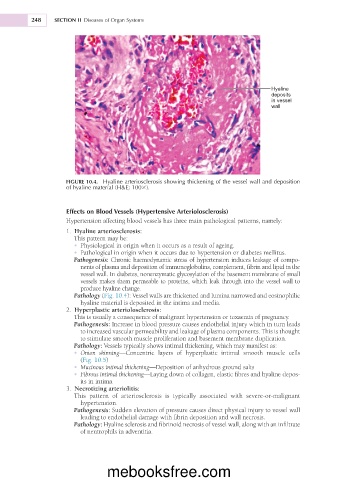
                     FIGURE 10.4.  Hyaline arteriosclerosis showing thickening of the vessel wall and deposition
                     of hyaline material (H&E; 1003).


                     Effects on Blood Vessels (Hypertensive Arteriolosclerosis)
                     Hypertension affecting blood vessels has three main pathological patterns, namely:
                       1.  Hyaline arteriosclerosis:
                        This pattern may be:
                        •  Physiological in origin when it occurs as a result of ageing.
                        •  Pathological in origin when it occurs due to hypertension or diabetes mellitus.
                        Pathogenesis: Chronic haemodynamic stress of hypertension induces leakage of compo-
                          nents of plasma and deposition of immunoglobulins, complement, fibrin and lipid in the
                          vessel wall. In diabetes, nonenzymatic glycosylation of the basement membrane of small
                          vessels makes them permeable to proteins, which leak through into the vessel wall to
                          produce hyaline change.
                        Pathology (Fig. 10.4): Vessel walls are thickened and lumina narrowed and eosinophilic
                          hyaline material is deposited in the intima and media.
                       2.  Hyperplastic arteriolosclerosis:
                        This is usually a consequence of malignant hypertension or toxaemia of pregnancy.
                        Pathogenesis: Increase in blood pressure causes endothelial injury which in turn leads
                          to increased vascular permeability and leakage of plasma components. This is thought
                          to stimulate smooth muscle proliferation and basement membrane duplication.
                        Pathology: Vessels typically shows intimal thickening, which may manifest as:
                        •  Onion  skinning—Concentric  layers  of  hyperplastic  intimal  smooth  muscle  cells
                          (Fig. 10.5)
                        •  Mucinous intimal thickening—Deposition of anhydrous ground salts
                        •  Fibrous intimal thickening—Laying down of collagen, elastic fibres and hyaline depos-
                          its in intima.
                       3.  Necrotizing arteriolitis:
                        This  pattern  of  arteriosclerosis  is  typically  associated  with  severe-or-malignant
                          hypertension.
                        Pathogenesis: Sudden elevation of pressure causes direct physical injury to vessel wall
                          leading to endothelial damage with fibrin deposition and wall necrosis.
                        Pathology: Hyaline sclerosis and fibrinoid necrosis of vessel wall, along with an infiltrate
                          of neutrophils in adventitia.


                                  mebooksfree.com

