


Page 259 - Concise Pathology for Exam Preparation ( PDFDrive )
P. 259
244    SECTION II  Diseases of Organ Systems

                     Clinical Features of Atherosclerosis

                     •  Most often and most severely affected are elastic arteries like abdominal aorta, ca-
                       rotids and iliac; and large- and medium-sized muscular arteries like coronary and
                       popliteal.
                     •  Symptomatic plaques most often involve arteries supplying the heart, brain, kidneys
                       and lower extremities.
                     •  Major clinical consequences of atherosclerosis are:
                       •  Myocardial infarction (heart attack)
                       •  Cerebral infarction (stroke)
                       •  Intermittent  claudication  and  peripheral  vascular  disease  (gangrene)  of  lower
                         extremities
                       •  Ischaemic bowel disease, infarction and ischaemic strictures of intestine
                       •  Renovascular hypertension


                     Complications of Atherosclerosis
                       1.  Calcification:  Occurs  in  advanced  plaques,  especially  in  aorta  and  coronaries.  The
                        diseased intima crackles like egg shell when incised.
                       2.  Ulceration: Layers covering the soft pultaceous material of an atheroma may ulcerate
                        due to trauma or haemodynamic force.
                       3.  Thromboembolization: Thrombosis occurs due to ulceration of the plaque and endo-
                        thelial  damage.  Emboli  composed  of  lipid  material  and  debris  may  arise  from  the
                        thrombi.
                       4.  Haemorrhage: Originates either from the luminal blood or rupture of thin capillaries
                        in adventitia.
                       5.  Aneurysm  formation: Severe atherosclerosis causes atrophy and thinning of media
                        with fragmentation of internal elastic lamina resulting in weakening of vessel wall and
                        aneurysm formation.
                       6.  Progressive plaque growth: Causes critical stenosis and obstruction of the vessel.


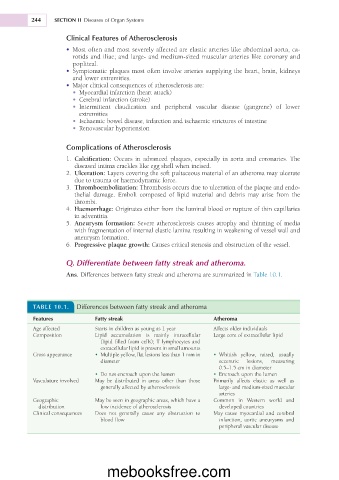
                     Q. Differentiate between fatty streak and atheroma.
                     Ans. Differences between fatty streak and atheroma are summarized in Table 10.1.


           TABLE 10.1.   Differences between fatty streak and atheroma

           Features           Fatty streak                         Atheroma
           Age affected       Starts in children as young as 1 year   Affects older individuals
           Composition        Lipid  accumulation  is  mainly  intracellular    Large core of extracellular lipid
                                (lipid filled foam cells); T lymphocytes and
                                extracellular lipid is present in small amounts
           Gross appearance   •  Multiple yellow, flat lesions less than 1 mm in   •  Whitish  yellow,  raised,  usually
                                diameter                            eccentric   lesions,   measuring
                                                                    0.5–1.5 cm in diameter
                              •  Do not encroach upon the lumen    •  Encroach upon the lumen
           Vasculature involved  May  be  distributed  in  areas  other  than  those   Primarily  affects  elastic  as  well  as
                                generally affected by atherosclerosis  large- and medium-sized muscular
                                                                    arteries
           Geographic         May be seen in geographic areas, which have a   Common  in  Western  world  and
             distribution       low incidence of atherosclerosis    developed countries
           Clinical consequences  Does  not  generally  cause  any  obstruction  to   May cause myocardial and cerebral
                                blood flow                          infarction,  aortic  aneurysms  and
                                                                    peripheral vascular disease


                                  mebooksfree.com

