


Page 287 - Concise Pathology for Exam Preparation ( PDFDrive )
P. 287
272    SECTION II  Diseases of Organ Systems


                         (b)  Common serologic tests done are
                             (i)  Antistreptolysin O (ASO) levels: Single titer of ASO more than 200 Todd units
                               in adults and 300 Todd units in children above 5 years, are taken as positive.
                               However, a rising titer is even more significant.
                            (ii)  Anti-DNase B levels
                             (iii)  Antihyaluronidase (AH) levels
                            (iv)  Antistreptozyme test (ASTZ) levels: Very sensitive indicator of recent strepto-
                               coccal infection. Titers more than 200 U/mL are considered positive
                       3.  Acute	phase	reactants: These tests confirm the presence of an inflammatory process,
                        but are nonspecific:
                         (a)  Raised erythrocyte sedimentation rate (ESR)
                         (b)  Increased C-reactive protein (CRP)
                       4.  Haematologic	abnormalities	and	levels	of	serum	proteins:
                         (a)  Neutrophilic leukocytosis
                         (b)  Increase in serum complement level
                         (c)  Increase in serum mucoproteins, alpha-2 and gamma-globulin levels
                          (d)  Anaemia due to suppression of erythropoiesis
                      5.  Electrocardiogram: The most consistent abnormality is prolongation of the PR interval.
                       6.  X-ray	chest: Evidence of cardiac failure may be seen, like:
                         (a)  Cardiomegaly
                         (b)  Pulmonary congestion
                       7.  Echocardiography: Echocardiography may show
                         (a)  Myocardial dysfunction
                         (b)  Valvular dysfunction
                         (c)  Pericardial effusion
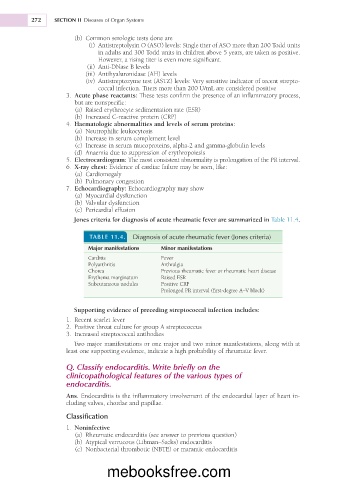
                        Jones	criteria	for	diagnosis	of	acute	rheumatic	fever	are	summarized	in	Table 11.4.

                             TABLE 11.4.  Diagnosis of acute rheumatic fever (Jones criteria)
                            Major manifestations   Minor manifestations
                            Carditis               Fever
                            Polyarthritis          Arthralgia
                            Chorea                 Previous rheumatic fever or rheumatic heart disease
                            Erythema marginatum    Raised ESR
                            Subcutaneous nodules   Positive CRP
                                                   Prolonged PR interval (first-degree A–V block)


                        Supporting	evidence	of	preceding	streptococcal	infection	includes:
                       1.  Recent scarlet fever
                       2.  Positive throat culture for group A streptococcus
                       3.  Increased streptococcal antibodies
                        Two major manifestations or one major and two minor manifestations, along with at
                     least one supporting evidence, indicate a high probability of rheumatic fever.

                     Q. Classify endocarditis. Write briefly on the
                     clinicopathological features of the various types of
                     endocarditis.
                     Ans. Endocarditis is the inflammatory involvement of the endocardial layer of heart in-
                     cluding valves, chordae and papillae.
                     Classification

                       1.  Noninfective
                         (a)  Rheumatic endocarditis (see answer to previous question)
                         (b)  Atypical verrucous (Libman–Sacks) endocarditis
                         (c)  Nonbacterial thrombotic (NBTE) or marantic endocarditis


                                  mebooksfree.com

