


Page 293 - Concise Pathology for Exam Preparation ( PDFDrive )
P. 293
278    SECTION II  Diseases of Organ Systems

                     Infective myocarditis

                     This is the most common type of myocarditis. It results from direct invasion of causative
                     organisms or their toxins into the myocardium or a destructive immune response to their
                     antigens. Common causes include
                     •	 Viral
                       •	 Seen in 5% of viral infections due to direct viral cytotoxicity or a destructive cell-
                         mediated immune reaction
                       •	 Myocardium is pale and flabby; focal or patchy necrosis and mural thrombi may be
                         seen on gross examination. Microscopy shows oedema and infiltration by neutro-
                         phils, which in the later stages are replaced by lymphocytes and macrophages
                     •	 Bacterial
                       •	 Myocardium shows abscesses
                       •	 Exudate  is  chiefly  composed  of  neutrophils,  lymphocytes,  plasma  cells  and  macro-
                         phages
                       •	 Coagulative necrosis may be seen
                     •	 Helminthic
                        Echinococcus granulosus and Trichinella spiralis are generally implicated.
                     •	 Fungal
                        Seen in immune deficiency, cancer and chronic debilitating diseases
                     •	 Protozoal	(Chagas	disease)
                        Mixed inflammation around parasitized myofibres is seen.
                     Q. Enumerate and describe the various types of cardiomyopathies.

                     Ans. Cardiomyopathy (CMP) is a heterogeneous group of diseases associated with me-
                     chanical and electrical dysfunction of the myocardium. Cardiomyopathies  may be local-
                     ized to the heart or may form a part of a systemic disease.
                       1.  Primary	cardiomyopathy: Diseases confined to heart muscle. May be genetic or ac-
                        quired in origin.
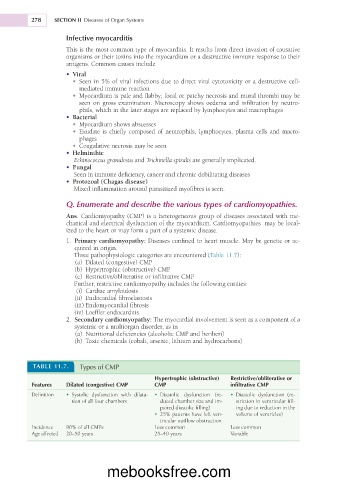
                        Three pathophysiologic categories are encountered (Table 11.7):
                         (a)  Dilated (congestive) CMP
                         (b)  Hypertrophic (obstructive) CMP
                         (c)  Restrictive/obliterative or infiltrative CMP
                        Further, restrictive cardiomyopathy includes the following entities:
                         (i)  Cardiac amyloidosis
                         (ii)  Endocardial fibroelastosis
                          (iii) Endomyocardial fibrosis
                          (iv) Loeffler endocarditis
                       2.  Secondary	cardiomyopathy: The myocardial involvement is seen as a component of a
                        systemic or a multiorgan disorder, as in
                         (a)  Nutritional deficiencies (alcoholic CMP and beriberi)
                         (b)  Toxic chemicals (cobalt, arsenic, lithium and hydrocarbons)


           TABLE 11.7.    Types of CMP
                                                 Hypertrophic (obstructive)   Restrictive/obliterative or
           Features  Dilated (congestive) CMP    CMP                    infiltrative CMP
           Definition  •  Systolic  dysfunction  with  dilata-  •  Diastolic  dysfunction  (re-  •  Diastolic  dysfunction  (re-
                       tion of all four chambers  duced chamber size and im-  striction in ventricular fill-
                                                  paired diastolic filling)  ing due to reduction in the
                                                 •  25% patients have left ven-  volume of ventricles)
                                                  tricular outflow obstruction
           Incidence  90% of all CMPs            Less common            Less common
           Age affected  20–50 years             25–40 years            Variable


                                  mebooksfree.com

