


Page 348 - Concise Pathology for Exam Preparation ( PDFDrive )
P. 348
12  Haematology  333

             Variants of RS Cells
               1.  Mononuclear  variants:  Single  round  to  oblong  nucleus  with  a  large  inclusion-like
                nucleolus
               2.  Lacunar cells: Predominantly seen in NS subtype. Delicate, folded and multilobated
                nucleus with abundant pale cytoplasm often disrupted while cutting sections. Nucleus
                appears to be sitting in a hole (lacuna).
               3.  L and H variants:
                RS cells undergo mummification (shrinkage and pyknosis) to give rise to cells with
                  polypoid nuclei resembling popcorn, having inconspicuous nucleoli and moderate
                  to abundant cytoplasm. Usually seen in the LP subtype.

             Note: RS-like cells may be seen in solid cancers, non-Hodgkin lymphoma and infectious
             mononucleosis.  For  diagnosing  ‘HL’,  RS  cells  must  be  present  in  a  background  of
             non-neoplastic cells (lymphocytes, plasma cells and eosinophils).

             Aetiology and Pathogenesis

             •  The  cell	 of	 origin	 of	 RS	 cells	 is	 thought	 to	 be	 a	 germinal	 centre	 or	 postgerminal	 centre
               B	lymphocyte.
             •  Rarely  (1–2%  cases)  RS  cells  have  TCR  rearrangements  suggesting  origin	from	trans-
               formed	T	cells.
             •  EBV  episomes  are  frequently  present  in  RS  cells.  EBV-positive  tumour  cells  express
               latent  membrane  protein  or  LMP-1  (a  protein  encoded  by  EBV  genome  that  has
               transforming activity).
             •  LMP-1 upregulates	NF-KB (transcription factor responsible for lymphocyte activation).
             •  NF-KB activation appears to be a common event in classical EBV-positive HL (NF-KB
               activation in EBV-negative cases occurs by acquired mutation in a negative regulator
               IKB).
             •  NF-KB activation possibly rescues cells from apoptosis.
             •  Accumulation of reactive cells is thought to be in response to cytokines released by
               RS cells, eg, IL-5, IL-6, IL-13, TNF and GM CSF.

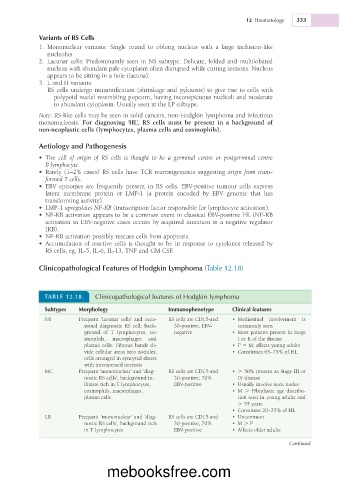
             Clinicopathological Features of Hodgkin Lymphoma (Table 12.18)


               TABLE 12.18.   Clinicopathological features of Hodgkin lymphoma

               Subtypes  Morphology                  Immunophenotype     Clinical features
               NS        Frequent  ‘lacunar  cells’  and  occa-  RS cells are CD15-and   •  Mediastinal  involvement  is
                           sional  diagnostic  RS  cell;  back-  30-positive; EBV-  commonly seen
                           ground  of  T  lymphocytes,  eo-  negative    •  Most patients present in Stage
                           sinophils,  macrophages  and                   I or II of the disease
                           plasma  cells.  Fibrous  bands  di-           •  F 5 M; affects young adults
                           vide cellular areas into nodules;             •  Constitutes 65–75% of HL
                           cells arranged in syncytial sheets
                           with interspersed necrosis
               MC        Frequent ‘mononuclear’ and ‘diag-  RS cells are CD15-and   •  . 50% present as Stage III or
                           nostic RS cells’; background in-  30-positive; 70%   IV disease
                           filtrate rich in T lymphocytes,   EBV-positive  •  Usually involve neck nodes
                           eosinophils, macrophages,                     •  M  .  F/biphasic  age  distribu-
                           plasma cells                                   tion seen in young adults and
                                                                          . 55 years
                                                                         •  Constitute 20–25% of HL
               LR        Frequent ‘mononuclear’ and ‘diag-  RS cells are CD15-and   •  Uncommon
                           nostic RS cells’, background rich   30-positive; 70%   •  M . F
                           in T lymphocytes            EBV-positive      •  Affects older adults

                                                                                          Continued


                                  mebooksfree.com

