


Page 349 - Concise Pathology for Exam Preparation ( PDFDrive )
P. 349
334    SECTION II  Diseases of Organ Systems


           TABLE 12.18.    Classification of Hodgkin lymphoma—cont’d

           Subtypes   Morphology                 Immunophenotype     Clinical features
           LD         Reticular variant: Many ‘diagnos-  RS cells are CD15 and   •  Affects older males
                       tic  RS  cells’  and  ‘variants’  with   30-positive; EBV-  •  Frequent association with HIV
                       paucity  of  background  reactive   positive    infection
                       cells.                                        •  Usually present with advanced
                      Diffuse fibrosis variant: Hypocel-               disease.
                       lular  fibrillar  background  with            •  Constitute , 5% cases of HL
                       scattered  ‘diagnostic  RS  cells’
                       and  ‘variants’  and  few  reactive
                       cells
           LP         Frequent ‘L and H (popcorn) cells’   RS cells are CD 20-pos-  •  Young males
                       in  the  background  of  follicular   itive, CD15-negative,   •  Cervical  and  axillary  lymph-
                       dendritic  cells  and  reactive  B   C D 3 0 - n e g a t i v e ,   adenopathy
                       cells                       EBV–BCL–6-positive  •  Rarely  involve  mediastinal
                      May  transform  into  a  large  B  cell   (BCL6  is  a  germinal   lymph nodes
                       lymphoma.                   centre  specific  tran-
                                                   scription factor)


                     Clinical Features
                     •  Painless enlargement of lymph nodes, which are discrete, nontender and rubbery
                     •  ‘Constitutional  symptoms’  (fever,  night  sweats,  unexplained  weight  loss  of  greater
                       than 10% body weight) are observed more with disseminated disease (Stages III and IV)
                       and mixed cellularity or lymphocyte depletion subtypes.
                     •  Classical ‘Pel–Ebstein’ fever (fever showing cyclical pattern; several days or weeks of
                       fever alternating with afebrile periods) is rare. An uncommon paraneoplastic symptom
                       involves occurrence of pain in affected lymph nodes on consumption of alcohol.
                     •  Cutaneous anergy due to depressed cell-mediated immunity may be seen.
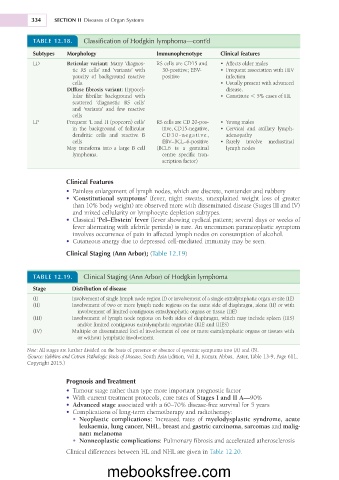
                     Clinical Staging (Ann Arbor); (Table 12.19)


           TABLE 12.19.    Clinical Staging (Ann Arbor) of Hodgkin lymphoma

           Stage       Distribution of disease
           (I)         Involvement of single lymph node region (I) or involvement of a single extralymphatic organ or site (IE)
           (II)        Involvement of two or more lymph node regions on the same side of diaphragm, alone (II) or with
                         involvement of limited contiguous extralymphatic organs or tissue (IIE)
           (III)       Involvement of lymph node regions on both sides of diaphragm, which may include spleen (IIIS)
                         and/or limited contiguous extralymphatic organ/site (IIIE and IIIES)
           (IV)        Multiple or disseminated foci of involvement of one or more extralymphatic organs or tissues with
                         or without lymphatic involvement

         Note:	All stages are further divided on the basis of presence or absence of systemic symptoms into (A) and (B).
         (Source:	Robbins	and	Cotran	Pathologic	Basis	of	Disease, South Asia Edition, Vol II, Kumar, Abbas,  Aster, Table 13-9, Page 611,
         Copyright 2015.)

                     Prognosis and Treatment
                     •  Tumour stage rather than type more important prognostic factor
                     •  With current treatment protocols, cure rates of Stages I and II A—90%
                     •  Advanced stage associated with a 60–70% disease-free survival for 5 years
                     •  Complications of long-term chemotherapy and radiotherapy:
                       •  Neoplastic  complications:  Increased  rates  of  myelodysplastic  syndrome,  acute
                         leukaemia, lung cancer, NHL, breast and gastric carcinoma, sarcomas and malig-
                         nant melanoma
                       •  Nonneoplastic complications: Pulmonary fibrosis and accelerated atherosclerosis
                     Clinical differences between HL and NHL are given in Table 12.20.


                                  mebooksfree.com

