


Page 350 - Concise Pathology for Exam Preparation ( PDFDrive )
P. 350
12  Haematology  335


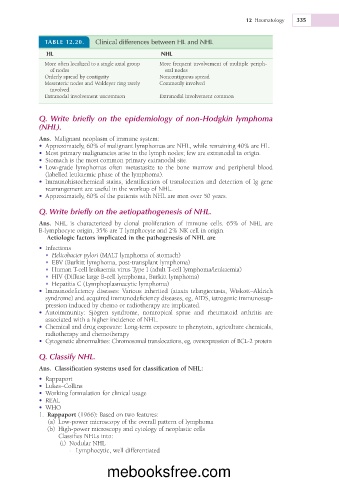
               TABLE 12.20.   Clinical differences between HL and NHL

                HL                                 NHL
               More often localized to a single axial group   More frequent involvement of multiple periph-
                 of nodes                           eral nodes
               Orderly spread by contiguity       Noncontiguous spread
               Mesenteric nodes and Waldeyer ring rarely   Commonly involved
                 involved
               Extranodal involvement uncommon    Extranodal involvement common


             Q. Write  briefly  on  the  epidemiology  of  non-Hodgkin  lymphoma
             (NHL).
             Ans.  Malignant neoplasm of immune system:
             •  Approximately, 60% of malignant lymphomas are NHL, while remaining 40% are HL.
             •  Most primary malignancies arise in the lymph nodes; few are extranodal in origin.
             •  Stomach is the most common primary extranodal site.
             •  Low-grade  lymphomas  often  metastasize  to  the  bone  marrow  and  peripheral  blood
               (labelled leukaemic phase of the lymphoma).
             •  Immunohistochemical stains, identification of translocation and detection of Ig gene
               rearrangement are useful in the workup of NHL.
             •  Approximately, 60% of the patients with NHL are men over 50 years.

             Q. Write briefly on the aetiopathogenesis of NHL.
             Ans.  NHL  is  characterized  by  clonal  proliferation  of  immune  cells.  65%  of  NHL  are
             B-lymphocyte origin, 35% are T lymphocyte and 2% NK cell in origin.
               Aetiologic factors implicated in the pathogenesis of NHL are
             •  Infections
               •  Helicobacter	pylori (MALT lymphoma of stomach)
               •  EBV (Burkitt lymphoma, post-transplant lymphoma)
               •  Human T-cell leukaemia virus Type I (adult T-cell lymphoma/leukaemia)
               •  HIV (Diffuse large B-cell lymphoma, Burkitt lymphoma)
               •  Hepatitis C (Lymphoplasmacytic lymphoma)
             •  Immunodeficiency  diseases:  Various  inherited  (ataxia  telangiectasia,  Wiskott–Aldrich
               syndrome) and acquired immunodeficiency diseases, eg, AIDS, iatrogenic immunosup-
               pression induced by chemo or radiotherapy are implicated.
             •  Autoimmunity:  Sjögren  syndrome,  nontropical  sprue  and  rheumatoid  arthritis  are
               associated with a higher incidence of NHL.
             •  Chemical and drug exposure: Long-term exposure to phenytoin, agriculture chemicals,
               radiotherapy and chemotherapy
             •  Cytogenetic abnormalities: Chromosomal translocations, eg, overexpression of BCL-2 protein

             Q. Classify NHL.
             Ans.  Classification systems used for classification of NHL:
             •  Rappaport
             •  Lukes–Collins
             •  Working formulation for clinical usage
             •  REAL
             •  WHO
               1.  Rappaport (1966): Based on two features:
                 (a)  Low-power microscopy of the overall pattern of lymphoma
                 (b)  High-power microscopy and cytology of neoplastic cells
                   Classifies NHLs into:
                    (i)  Nodular NHL
                      -  Lymphocytic, well differentiated


                                  mebooksfree.com

