


Page 347 - Concise Pathology for Exam Preparation ( PDFDrive )
P. 347
332    SECTION II  Diseases of Organ Systems

                     Q. Enumerate the causes of generalized lymphadenopathy.
                     Ans. Causes	of	generalized	lymphadenopathy
                     •  Disseminated tuberculosis
                     •  HIV-associated lymphadenopathy
                     •  Secondary syphilis
                     •  Infectious mononucleosis
                     •  Brucellosis
                     •  Systemic lupus erythaematosus and rheumatoid arthritis
                     •  Lymphomas
                     •  Leukaemias (ALL and CLL)
                     Neoplastic Proliferations of Lymph Nodes

                     Q. Write in detail on Hodgkin lymphoma (HL).
                     Ans.  HL has a bimodal age incidence; affects young adults (15–35 years) and older adults
                     (45–75 years). Reed–Sternberg (RS) cells are the diagnostic hallmark.

                     Classification

                     •  Nodular sclerosis (NS)  •  NS, MC, LR & LD are also called “classical HL”.
                     •  Mixed cellularity (MC)  •  All have RS cells with similar phenotype, positive
                     •  Lymphocyte rich (LR)      for PAX5 (a B cell transcription factor), CD15 and
                     •  Lymphocyte depleted (LD)  CD30 and negative for other markers.
                     •  Lymphocyte predominant (LP) → B-cell immunophenotype of RS cells (positive for
                        CD20 and BCL6 and negative for CD15 and CD30).


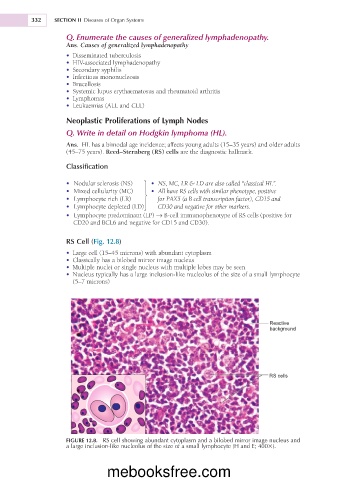
                     RS Cell (Fig. 12.8)
                     •  Large cell (15–45 microns) with abundant cytoplasm
                     •  Classically has a bilobed mirror image nucleus
                     •  Multiple nuclei or single nucleus with multiple lobes may be seen
                     •  Nucleus typically has a large inclusion-like nucleolus of the size of a small lymphocyte
                       (5–7 microns)


                                                                                    Reactive
                                                                                    background


                                                                                    RS cells


                     FIGURE 12.8.  RS cell showing abundant cytoplasm and a bilobed mirror image nucleus and
                     a large inclusion-like nucleolus of the size of a small lymphocyte (H and E; 4003).


                                  mebooksfree.com

