


Page 363 - Concise Pathology for Exam Preparation ( PDFDrive )
P. 363
348    SECTION II  Diseases of Organ Systems

                     Laboratory Diagnosis

                     •  Haemogram shows thrombocytopenia with a normocytic normochromic anaemia (con-
                       sequent to bleeding).
                     •  Peripheral blood smear shows large/giant platelets, reflecting the early release of mega-
                       karyocytic fragments into the circulation. Platelets lack granules or have an abnormal
                       colour. Lymphocytosis and eosinophilia are common.
                     •  Tests for antiplatelet antibodies and assays for platelet-associated immunoglobulin, or
                       antiplatelet antibodies are available.
                     •  Bone marrow shows an increase in the number of megakaryocytes and their precursors
                       which may show an abnormal morphology. There may be decreased cytoplasmic granu-
                       larity, variable staining, vacuolization of the cytoplasm and hypolobulation of the nuclei.

                     Q. Differentiate between acute and chronic ITP.
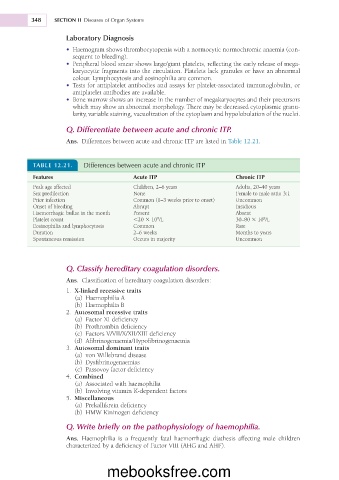
                     Ans.  Differences between acute and chronic ITP are listed in Table 12.21.


           TABLE 12.21.    Differences between acute and chronic ITP
           Features                       Acute ITP                       Chronic ITP
           Peak age affected              Children, 2–6 years             Adults, 20–40 years
           Sex predilection               None                            Female to male ratio 3:1
           Prior infection                Common (1–3 weeks prior to onset)  Uncommon
           Onset of bleeding              Abrupt                          Insidious
           Haemorrhagic bullae in the mouth  Present                      Absent
                                                                                  9
           Platelet count                 ,20 3 10 /L                     30–80 3 10 /L
                                                 9
           Eosinophilia and lymphocytosis  Common                         Rare
           Duration                       2–6 weeks                       Months to years
           Spontaneous remission          Occurs in majority              Uncommon


                     Q. Classify hereditary coagulation disorders.
                     Ans.  Classification of hereditary coagulation disorders:
                       1.  X-linked recessive traits
                         (a)  Haemophilia A
                         (b)  Haemophilia B
                       2.  Autosomal recessive traits
                         (a)  Factor XI deficiency
                         (b)  Prothrombin deficiency
                         (c)  Factors V/VII/X/XII/XIII deficiency
                          (d)  Afibrinogenaemia/Hypofibrinogenaemia
                       3.  Autosomal dominant traits
                         (a)  von Willebrand disease
                         (b)  Dysfibrinogenaemias
                         (c)  Passovoy factor deficiency
                       4.  Combined
                         (a)  Associated with haemophilia
                         (b)  Involving vitamin K-dependent factors
                       5.  Miscellaneous
                         (a)  Prekallikrein deficiency
                         (b)  HMW Kininogen deficiency

                     Q. Write briefly on the pathophysiology of haemophilia.

                     Ans.  Haemophilia  is  a  frequently  fatal  haemorrhagic  diathesis  affecting  male  children
                     characterized by a deficiency of Factor VIII (AHG and AHF).


                                  mebooksfree.com

