


Page 367 - Concise Pathology for Exam Preparation ( PDFDrive )
P. 367
352    SECTION II  Diseases of Organ Systems

                     Q. What is the clinical significance of the ABO blood group system?

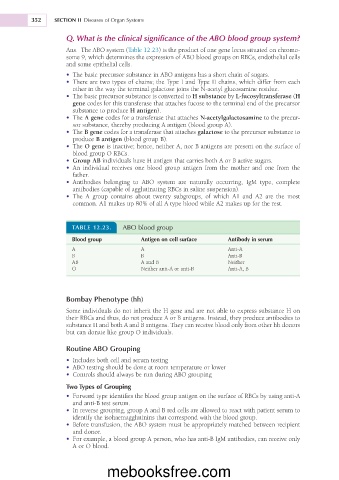
                     Ans.  The ABO system (Table 12.23) is the product of one gene locus situated on chromo-
                     some 9, which determines the expression of ABO blood groups on RBCs, endothelial cells
                     and some epithelial cells.
                     •  The basic precursor substance in ABO antigens has a short chain of sugars.
                     •  There are two types of chains; the Type I and Type II chains, which differ from each
                       other in the way the terminal galactose joins the N-acetyl glucosamine residue.
                     •  The basic precursor substance is converted to H substance by L-fucosyltransferase (H
                       gene codes for this transferase that attaches fucose to the terminal end of the precursor
                       substance to produce H antigen).
                     •  The A gene codes for a transferase that attaches N-acetylgalactosamine to the precur-
                       sor substance, thereby producing A antigen (blood group A).
                     •  The B gene codes for a transferase that attaches galactose to the precursor substance to
                       produce B antigen (blood group B).
                     •  The O gene is inactive; hence, neither A, nor B antigens are present on the surface of
                       blood group O RBCs.
                     •  Group AB individuals have H antigen that carries both A or B active sugars.
                     •  An  individual  receives  one  blood  group  antigen  from  the  mother  and  one  from  the
                       father.
                     •  Antibodies  belonging  to  ABO  system  are  naturally  occurring,  IgM  type,  complete
                       antibodies (capable of agglutinating RBCs in saline suspension).
                     •  The  A  group  contains  about  twenty  subgroups,  of  which  A1  and  A2  are  the  most
                       common. A1 makes up 80% of all A type blood while A2 makes up for the rest.


                       TABLE 12.23.    ABO blood group
                       Blood group          Antigen on cell surface    Antibody in serum
                       A                    A                          Anti-A
                       B                    B                          Anti-B
                       AB                   A and B                    Neither
                       O                    Neither anti-A or anti-B   Anti-A, B


                     Bombay Phenotype (hh)
                     Some individuals do not inherit the H gene and are not able to express substance H on
                     their RBCs and thus, do not produce A or B antigens. Instead, they produce antibodies to
                     substance H and both A and B antigens. They can receive blood only from other hh donors
                     but can donate like group O individuals.

                     Routine ABO Grouping
                     •  Includes both cell and serum testing
                     •  ABO testing should be done at room temperature or lower
                     •  Controls should always be run during ABO grouping

                     Two Types of Grouping
                     •  Forward type identifies the blood group antigen on the surface of RBCs by using anti-A
                       and anti-B test serum.
                     •  In reverse grouping, group A and B red cells are allowed to react with patient serum to
                       identify the isohaemagglutinins that correspond with the blood group.
                     •  Before transfusion, the ABO system must be appropriately matched between recipient
                       and donor.
                     •  For example, a blood group A person, who has anti-B IgM antibodies, can receive only
                       A or O blood.


                                  mebooksfree.com

