


Page 371 - Concise Pathology for Exam Preparation ( PDFDrive )
P. 371
13


                     The Lung


                     AIRWAYS

                     Function: Exchange of gases between inspired air and blood
                     Histology: The entire respiratory tree is lined by pseudostratified tall columnar ciliated
                       epithelium admixed with mucous-secreting goblet cells in the cartilaginous airways.
                       Bronchial  mucosa  also  has  neuroendocrine  cells  that  exhibit  neurosecretory-type
                       granules, which contain serotonin, calcitonin and gastrin-releasing peptide.
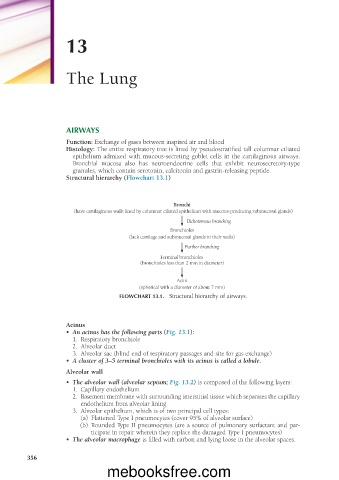
                     Structural hierarchy (Flowchart 13.1)


                                                      Bronchi
                        (have cartilaginous walls lined by columnar ciliated epithelium with mucous-producing submucosal glands)
                                                          Dichotomous branching
                                                     Bronchioles
                                         (lack cartilage and submucosal glands in their walls)
                                                          Further branching
                                                  Terminal bronchioles
                                            (bronchioles less than 2 mm in diameter)

                                                       Acini
                                            (spherical with a diameter of about 7 mm)
                                      FLOWCHART 13.1.  Structural hierarchy of airways.


                     Acinus
                     •  An acinus has the following parts (Fig. 13.1):
                        1.  Respiratory bronchiole
                        2.  Alveolar duct
                        3.  Alveolar sac (blind end of respiratory passages and site for gas exchange)
                     •  A cluster of 3–5 terminal bronchioles with its acinus is called a lobule.
                     Alveolar wall
                     •  The alveolar wall (alveolar septum; Fig. 13.2) is composed of the following layers:
                        1.  Capillary endothelium
                        2.  Basement membrane with surrounding interstitial tissue which separates the capillary
                          endothelium from alveolar lining
                        3.  Alveolar epithelium, which is of two principal cell types:
                           (a)  Flattened Type I pneumocytes (cover 95% of alveolar surface)
                           (b)  Rounded Type II pneumocytes (are a source of pulmonary surfactant and par-
                             ticipate in repair wherein they replace the damaged Type I pneumocytes)
                     •  The alveolar macrophage is filled with carbon and lying loose in the alveolar spaces.

         356

                                  mebooksfree.com

