


Page 397 - Concise Pathology for Exam Preparation ( PDFDrive )
P. 397
382    SECTION II  Diseases of Organ Systems


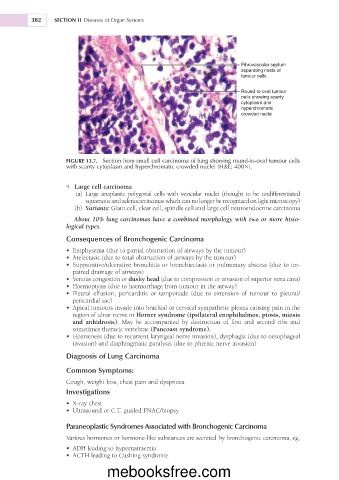
                                                                           Fibrovascular septum
                                                                           separating nests of
                                                                           tumour cells

                                                                           Round-to-oval tumour
                                                                           cells showing scanty
                                                                           cytoplasm and
                                                                           hyperchromatic
                                                                           crowded nuclei


                     FIGURE 13.7.  Section from small cell carcinoma of lung showing round-to-oval tumour cells
                     with scanty cytoplasm and hyperchromatic crowded nuclei (H&E; 4003).


                       4.  Large cell carcinoma
                         (a)  Large anaplastic polygonal cells with vesicular nuclei (thought to be undifferentiated
                           squamous and adenocarcinomas which can no longer be recognized on light microscopy)
                         (b)  Variants: Giant cell, clear cell, spindle cell and large cell neuroendocrine carcinoma

                        About 10% lung carcinomas have a combined morphology with two or more histo-
                     logical types.
                     Consequences of Bronchogenic Carcinoma

                     •  Emphysema (due to partial obstruction of airways by the tumour)
                     •  Atelectasis (due to total obstruction of airways by the tumour)
                     •  Suppurative/ulcerative bronchitis or bronchiectasis or pulmonary abscess (due to im-
                       paired drainage of airways)
                     •  Venous congestion or dusky head (due to compression or invasion of superior vena cava)
                     •  Haemoptysis (due to haemorrhage from tumour in the airway)
                     •  Pleural  effusion,  pericarditis  or  tamponade  (due  to  extension  of  tumour  to  pleural/
                       pericardial sac)
                     •  Apical tumours invade into brachial or cervical sympathetic plexus causing pain in the
                       region of ulnar nerve or Horner syndrome (ipsilateral enophthalmos, ptosis, miosis
                       and  anhidrosis).  May  be  accompanied  by  destruction  of  first  and  second  ribs  and
                       sometimes thoracic vertebrae (Pancoast syndrome).
                     •  Hoarseness (due to recurrent laryngeal nerve invasion), dysphagia (due to oesophageal
                       invasion) and diaphragmatic paralysis (due to phrenic nerve invasion)

                     Diagnosis of Lung Carcinoma
                     Common Symptoms:

                     Cough, weight loss, chest pain and dyspnoea
                     Investigations

                     •  X-ray chest
                     •  Ultrasound or C.T. guided FNAC/biopsy

                     Paraneoplastic Syndromes Associated with Bronchogenic Carcinoma

                     Various hormones or hormone-like substances are secreted by bronchogenic carcinoma, eg,
                     •  ADH leading to hypernatraemia
                     •  ACTH leading to Cushing syndrome

                                  mebooksfree.com

