


Page 396 - Concise Pathology for Exam Preparation ( PDFDrive )
P. 396
13  The Lung  381


                 (d)  Well-differentiated lesions show minimal atypia, intercellular bridges as well as abun-
                   dant keratin (keratinization is seen as numerous keratin pearls as well as individual
                   cell keratinization. Squamous cells with intracellular keratin demonstrate abundant
                   dense eosinophilic cytoplasm).
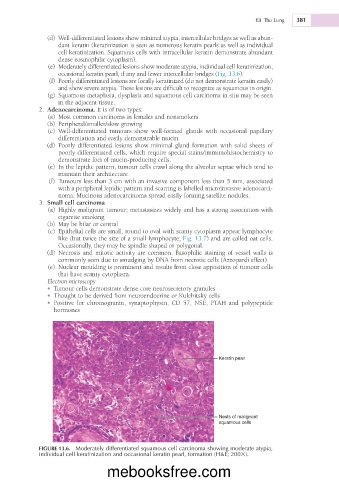
                 (e)  Moderately differentiated lesions show moderate atypia, individual cell keratinization,
                   occasional keratin pearl, if any and fewer intercellular bridges (Fig. 13.6).
                 (f)  Poorly differentiated lesions are focally keratinized (do not demonstrate keratin easily)
                   and show severe atypia. These lesions are difficult to recognize as squamous in origin.
                 (g)  Squamous metaplasia, dysplasia and squamous cell carcinoma in situ may be seen
                   in the adjacent tissue.
               2.  Adenocarcinoma. It is of two types:
                 (a)  Most common carcinoma in females and nonsmokers
                 (b)  Peripheral/smaller/slow growing
                 (c)  Well-differentiated  tumours  show  well-formed  glands  with  occasional  papillary
                   differentiation and easily demonstrable mucin.
                  (d)  Poorly differentiated lesions show minimal gland formation with solid sheets of
                   poorly differentiated cells, which require special stains/immunohistochemistry to
                   demonstrate foci of mucin-producing cells.
                 (e)  In the lepidic pattern, tumour cells crawl along the alveolar septae which tend to
                   maintain their architecture.
                 (f)  Tumours less than 3 cm with an invasive component less than 5 mm, associated
                   with a peripheral lepidic pattern and scarring is labelled microinvasive adenocarci-
                   noma. Mucinous adenocarcinoma spread easily forming satellite nodules.
               3.  Small cell carcinoma
                 (a)  Highly malignant tumour; metastasizes widely and has a strong association with
                   cigarette smoking
                 (b)  May be hilar or central
                 (c)  Epithelial cells are small, round to oval with scanty cytoplasm appear lymphocyte
                   like (but twice the size of a small lymphocyte; Fig. 13.7) and are called oat cells.
                   Occasionally, they may be spindle shaped or polygonal.
                  (d)  Necrosis and mitotic activity are common. Basophilic staining of vessel walls is
                   commonly seen due to smudging by DNA from necrotic cells (Azzopardi effect).
                 (e)  Nuclear moulding is prominent and results from close apposition of tumour cells
                   that have scanty cytoplasm.
                Electron microscopy
                •  Tumour cells demonstrate dense core neurosecretory granules
                •  Thought to be derived from neuroendocrine or Kulchitsky cells
                •  Positive  for  chromogranin,  synaptophysin,  CD  57,  NSE,  PTAH  and  polypeptide
                  hormones


                                                                    Keratin pearl


                                                                    Nests of malignant
                                                                    squamous cells


             FIGURE 13.6.  Moderately differentiated squamous cell carcinoma showing moderate atypia,
             individual cell keratinization and occasional keratin pearl, formation (H&E; 2003).

                                  mebooksfree.com

