


Page 395 - Concise Pathology for Exam Preparation ( PDFDrive )
P. 395
380    SECTION II  Diseases of Organ Systems


                         (c)  Asbestosis (particularly, when coupled with smoking)
                          (d)  Nickel, chromates, coal, mustard and arsenic
                       3.  Indoor air pollutants (eg, radon) have been implicated.
                       4.  Role of molecular genetics:
                         (a)  Loss of tumour suppressor genes like P53, RB1 and inactivation of CDK in-
                           hibitor P 16  are seen equally in adeno and squamous cell carcinoma. P53 and RB1
                           mutations are common in small cell carcinoma as well. Small cell carcinomas also
                           commonly demonstrate amplification of genes of MYC family.
                         (b)  Gain of function mutations involving the growth factor receptor signalling path-
                           ways (genes encoding receptor tyrosine kinases, eg, EGFR, ALK, ROS, MET
                           and RET), amplifications in epidermal growth factor receptor (EGFR) gene and
                           mutations in KRAS are typically seen in patients with adenocarcinoma.
                         (c)  Allelic losses on short arm of chromosomes 3, 9 and 17 may precede invasion in
                           squamous cell carcinoma.
                       5.  Scarring
                         (a)  Scars are most often encountered in the vicinity of adenocarcinomas.
                         (b)  In most cases, scar is a desmoplastic response to tumour; occasionally, scar may
                           precede  carcinoma  (old  infarcts,  foreign  bodies,  wounds  and  granulomatous
                           inflammation).

                     Four types of Precursor Lesions are recognized:
                       1)  Squamous dysplasia and carcinoma in situ
                       2)  Atypical adenomatous hyperplasia (small , 5 mm lesions, solitary or multiple, composed
                        of dysplastic pneumocytes lining fibrosed alveolar walls)
                       3)  Adenocarcinoma in situ (formerly called bronchioloalveolar carcinoma it is a lesion
                        smaller than 3 cm. It is constituted by dysplastic cells which grow along alveolar septa.)
                       4)  Diffuse idiopathic pulmonary neuroendocrine cell hyperplasia.

                     Morphology
                     •  Most common location is the hilar region.
                     •  Most lesions arise from 1st, 2nd and 3rd order bronchi; few arise from peripheral al-
                       veolar septal cells and terminal bronchioles.
                     •  Peripheral tumours are usually adenocarcinomas.

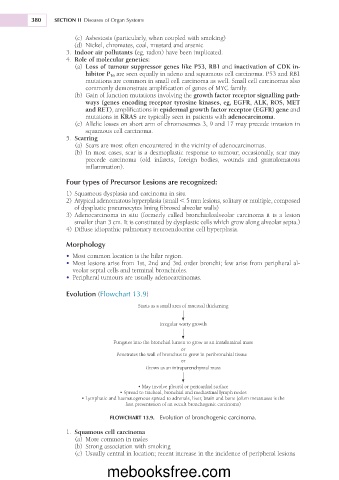
                     Evolution (Flowchart 13.9)
                                            Starts as a small area of mucosal thickening


                                                  Irregular warty growth

                                    Fungates into the bronchial lumen to grow as an intraluminal mass
                                                         or
                                     Penetrates the wall of bronchus to grow in peribronchial tissue
                                                         or
                                              Grows as an intraparenchymal mass


                                            • May involve pleural or pericardial surface
                                      • Spread to tracheal, bronchial and mediastinal lymph nodes
                          • Lymphatic and haematogenous spread to adrenals, liver, brain and bone (often metastases is the
                                        first presentation of an occult bronchogenic carcinoma)

                                   FLOWCHART 13.9.  Evolution of bronchogenic carcinoma.
                       1.  Squamous cell carcinoma
                         (a)  More common in males
                         (b)  Strong association with smoking
                         (c)  Usually central in location; recent increase in the incidence of peripheral lesions


                                  mebooksfree.com

