


Page 392 - Concise Pathology for Exam Preparation ( PDFDrive )
P. 392
13  The Lung  377


               4.  Asbestos-related disease
                 (a)  Prolonged exposure to asbestos dust produces three types of diseases:
                     (i)  Asbestosis of lungs (parenchymal interstitial fibrosis)
                    (ii)  Pleural disease (localized fibrous plaques or diffuse fibrosis)
                     (iii)  Tumours  (bronchogenic  carcinoma,  pleural  and  peritoneal  mesotheliomas,
                       laryngeal carcinoma)
                 (b)  Asbestos is a family of crystalline hydrated silicates that form fibres which may exist
                   as two distinct geometric forms:
                    (i)  Serpentine (chrysotile): Curly and flexible fibres (90% of commercial form of
                      asbestos)
                     (ii)  Amphibole: Straight, stiff and brittle fibres
                 (c)  Amphiboles  are  less  prevalent  but  more  pathogenic  than  chrysotile  as  they  are
                   more rigid and less soluble.
                  (d)  High-risk individuals include miners, millers and fabrication workers
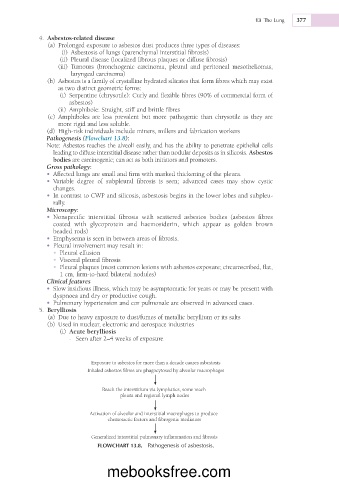
               Pathogenesis (Flowchart 13.8):
               Note: Asbestos reaches the alveoli easily, and has the ability to penetrate epithelial cells
                 leading to diffuse interstitial disease rather than nodular deposits as in silicosis. Asbestos
                 bodies are carcinogenic; can act as both initiators and promoters.
               Gross pathology:
               •  Affected lungs are small and firm with marked thickening of the pleura.
               •  Variable  degree  of  subpleural  fibrosis  is  seen;  advanced  cases  may  show  cystic
                 changes.
               •  In contrast to CWP and silicosis, asbestosis begins in the lower lobes and subpleu-
                 rally.
               Microscopy:
               •  Nonspecific  interstitial  fibrosis  with  scattered  asbestos  bodies  (asbestos  fibres
                 coated  with  glycoprotein  and  haemosiderin,  which  appear  as  golden  brown
                 beaded rods)
               •  Emphysema is seen in between areas of fibrosis.
               •  Pleural involvement may result in:
                 •  Pleural effusion
                 •  Visceral pleural fibrosis
                 •  Pleural plaques (most common lesions with asbestos exposure; circumscribed, flat,
                   1 cm, firm-to-hard bilateral nodules)
               Clinical features
               •  Slow insidious illness, which may be asymptomatic for years or may be present with
                 dyspnoea and dry or productive cough.
               •  Pulmonary hypertension and cor pulmonale are observed in advanced cases.
               5.  Berylliosis
                 (a)  Due to heavy exposure to dust/fumes of metallic beryllium or its salts
                 (b)  Used in nuclear, electronic and aerospace industries
                    (i)  Acute berylliosis
                      -  Seen after 2–4 weeks of exposure


                             Exposure to asbestos for more than a decade causes asbestosis
                            Inhaled asbestos fibres are phagocytosed by alveolar macrophages

                                Reach the interstitium via lymphatics, some reach
                                      pleura and regional lymph nodes


                             Activation of alveolar and interstitial macrophages to produce
                                  chemotactic factors and fibrogenic mediators

                             Generalized interstitial pulmonary inflammation and fibrosis
                               FLOWCHART 13.8.  Pathogenesis of asbestosis.


                                  mebooksfree.com

