


Page 403 - Concise Pathology for Exam Preparation ( PDFDrive )
P. 403
388
           388    SECTION II  Diseases of Organ Systems


                                                                           Normal
                                                                           salivary
                                                                           tissue


                                                                           Epithelial components
                                                                           (ductal and myoepithelial
                       A                                                   cells) are seen forming
                                                                           ducts, acini, and tubules


                                                                           Myxoid or
                                                                           pseudochondroid
                                                                           stroma
                       B
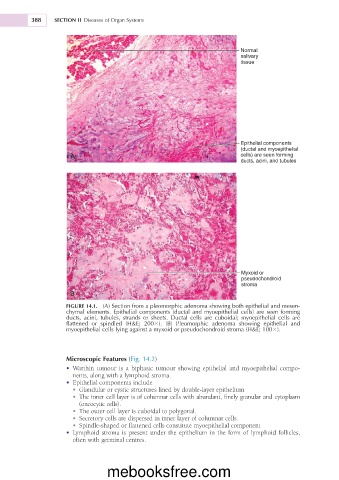
                     FIGURE 14.1.  (A) Section from a pleomorphic adenoma showing both epithelial and mesen-
                     chymal elements. Epithelial components (ductal and myoepithelial cells) are seen forming
                     ducts,  acini,  tubules,  strands  or  sheets.  Ductal  cells  are  cuboidal;  myoepithelial  cells  are
                     flattened  or  spindled  (H&E;  2003).  (B)  Pleomorphic  adenoma  showing  epithelial  and
                     myoepithelial cells lying against a myxoid or pseudochondroid stroma (H&E; 1003).


                     Microscopic Features (Fig. 14.2)
                     •	 Warthin  tumour  is  a  biphasic  tumour  showing  epithelial  and  myoepithelial  compo-
                       nents, along with a lymphoid stroma.
                     •	 Epithelial components include
                       •	 Glandular or cystic structures lined by double-layer epithelium
                       •	 The inner cell layer is of columnar cells with abundant, finely granular and cytoplasm
                         (oncocytic cells).
                       •	 The outer cell layer is cuboidal to polygonal.
                       •	 Secretory cells are dispersed in inner layer of columnar cells.
                       •	 Spindle-shaped or flattened cells constitute myoepithelial component
                     •	 Lymphoid stroma is present under the epithelium in the form of lymphoid follicles,
                       often with germinal centres.


                                  mebooksfree.com

